
Europe

Marketing Communication. Capital at risk. For Professional Investors Only. Please read fund legal documentation before making any final investment decisions.
AI, electrification and reindustrialisation have a common trait: reliance on batteries. EVs dominate the modern battery industry and still account for more than 70% of battery demand, however the power grid has become its second engine of growth.¹ Grid-scale battery energy storage systems (BESS), which store electricity for utilities and grid operators, make up around 80% of new storage capacity.²
Critically for investors, the companies that make EV batteries increasingly supply grid batteries in parallel. CATL, which produces around 40% of EV batteries is also the largest supplier of grid storage cells.³ Battery makers are therefore no longer pure EV plays: two end markets diversify their revenue and reduce dependence on any one demand cycle.
Innovation needs scale to reach the market, so new chemistries like sodium-ion and solid-state are strengthening the largest battery makers, rather than displacing them. With AI, electrification and reindustrialisation all running on batteries, the companies that make them, and the miners that supply the materials, sit at the centre of three of the decade’s biggest growth stories.
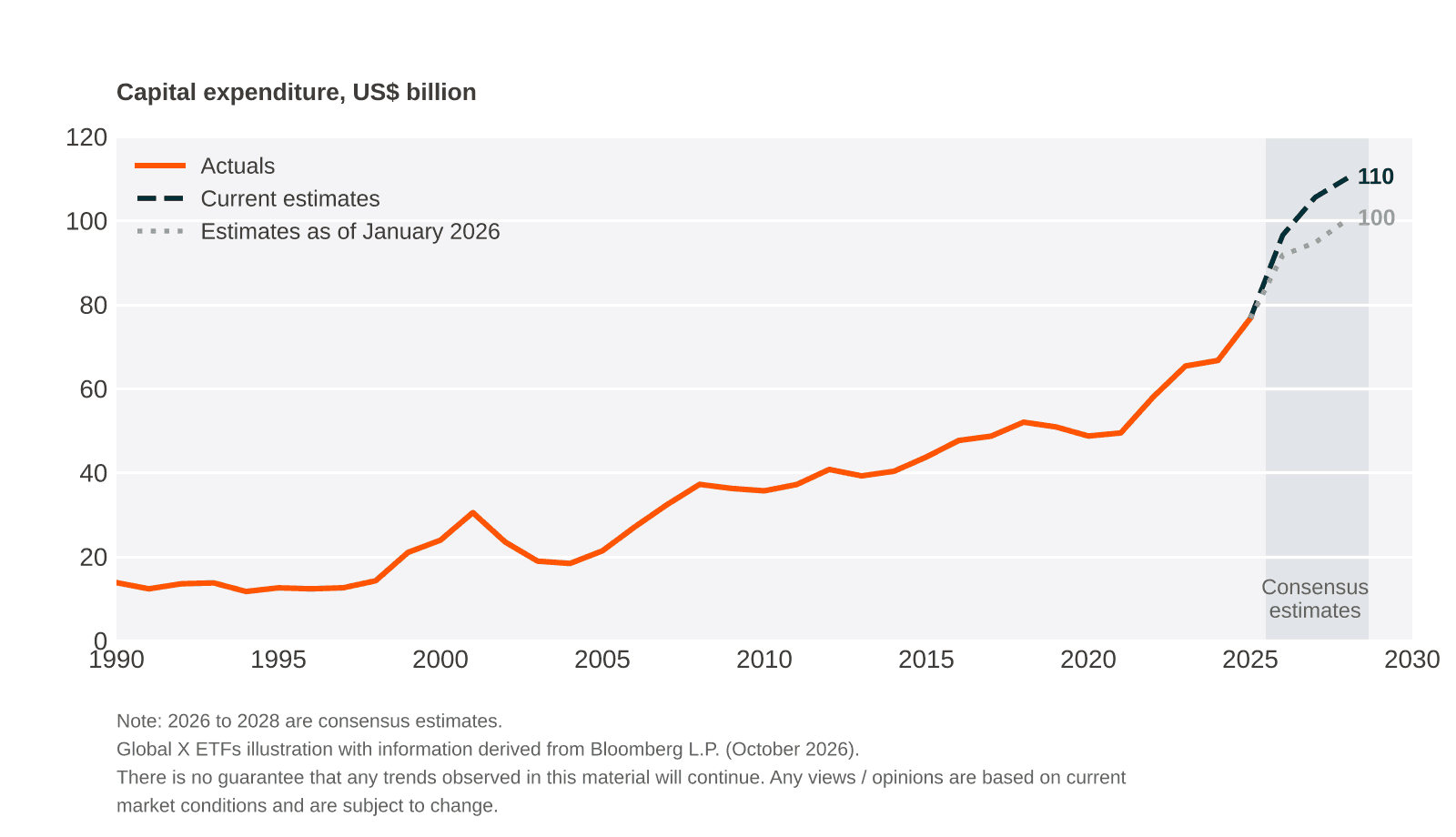
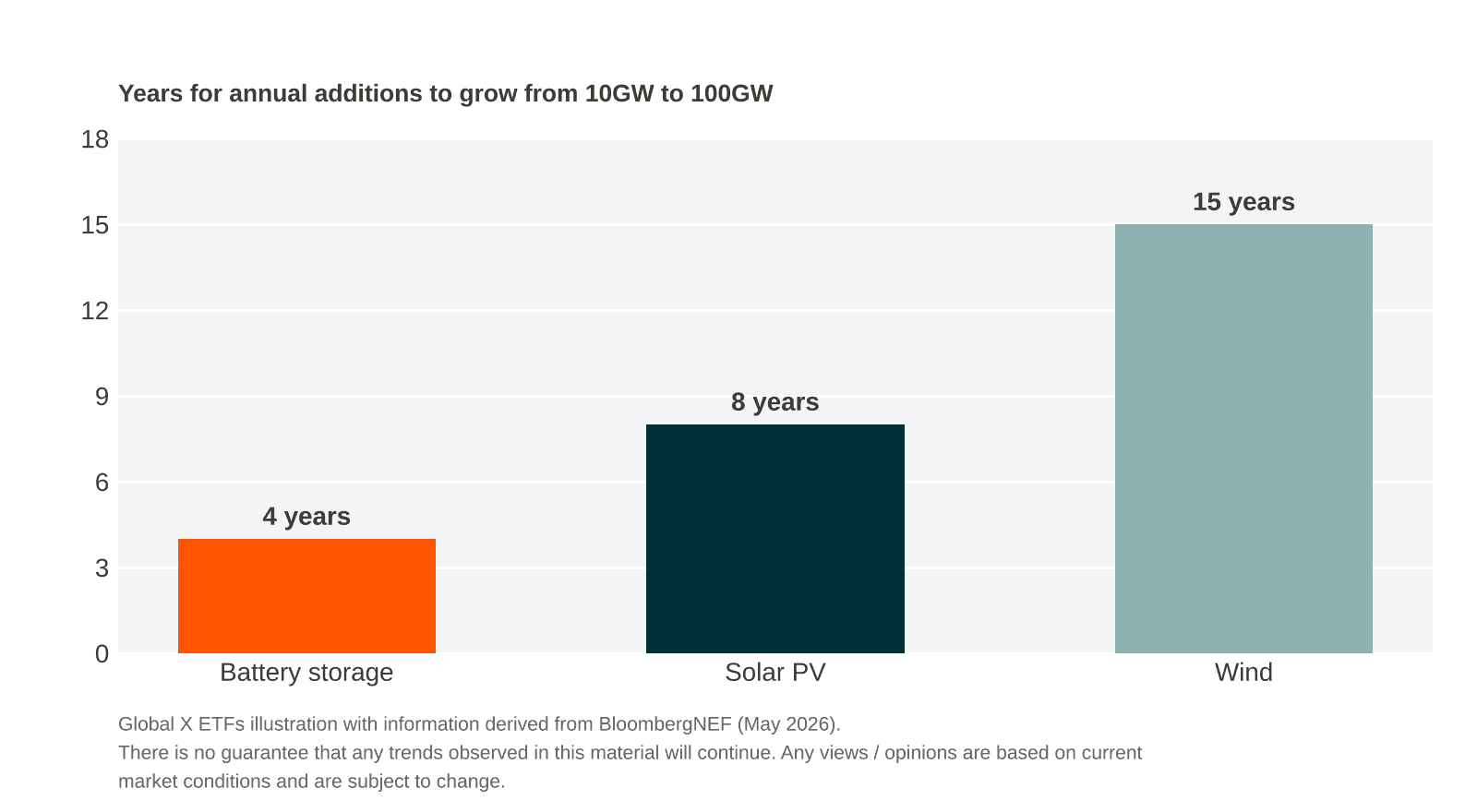
Annual battery storage additions went from 10GW to over 100GW in just 4 years, a scale-up that took solar 8 years and wind 15.⁴ The battery is now part of the grid, and therefore downstream of the investment flowing into it. US utilities plan $1.4 trillion of investment through 2030, with $239 billion of that coming in 2026, up 17% on a record 2025.⁵
Figure 1: US Electric Utility Capex, with Consensus Estimates
Categorising battery demand as a purely EV story is now an oversimplification. While EV adoption still carries momentum, the high-velocity growth in batteries is now coming from:
The result is a demand base with two legs instead of one. The car base is large, growing but policy-sensitive, whilst the grid is smaller but tied to long-life infrastructure. Both have benefitted in 2026 from a combination of geopolitical & energy shocks, innovation and improved battery economics.¹⁰
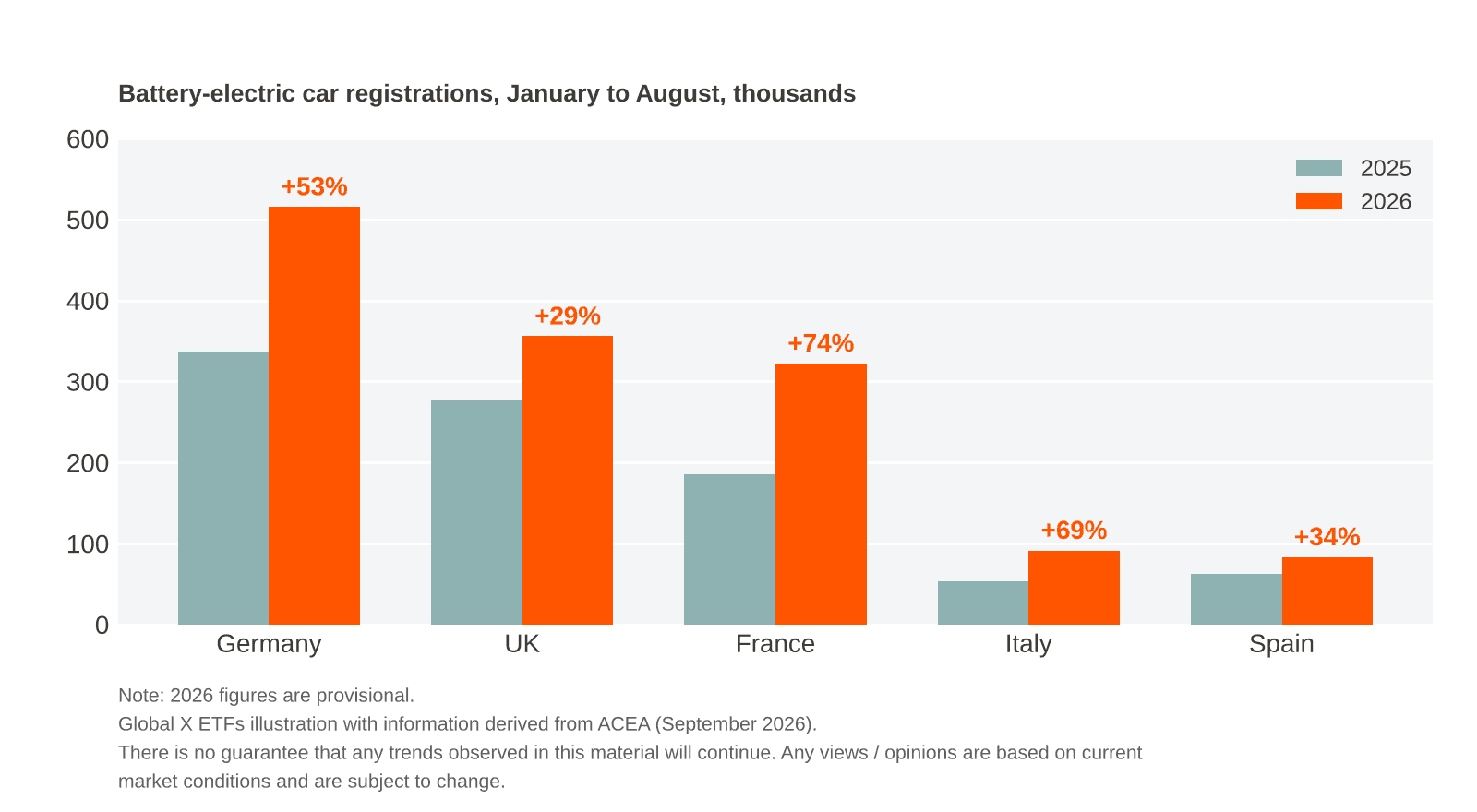
EVs remain the anchor of battery demand: they accounted for more than 70% of global battery deployment in 2025, down from almost 80% in 2024 and are rising incrementally in 2026, especially in Europe.¹¹ EV registrations across the EU, EFTA and UK rose 29% in the first 8 months of 2026.¹²
European Countries’ EV Demand Growth in 2026
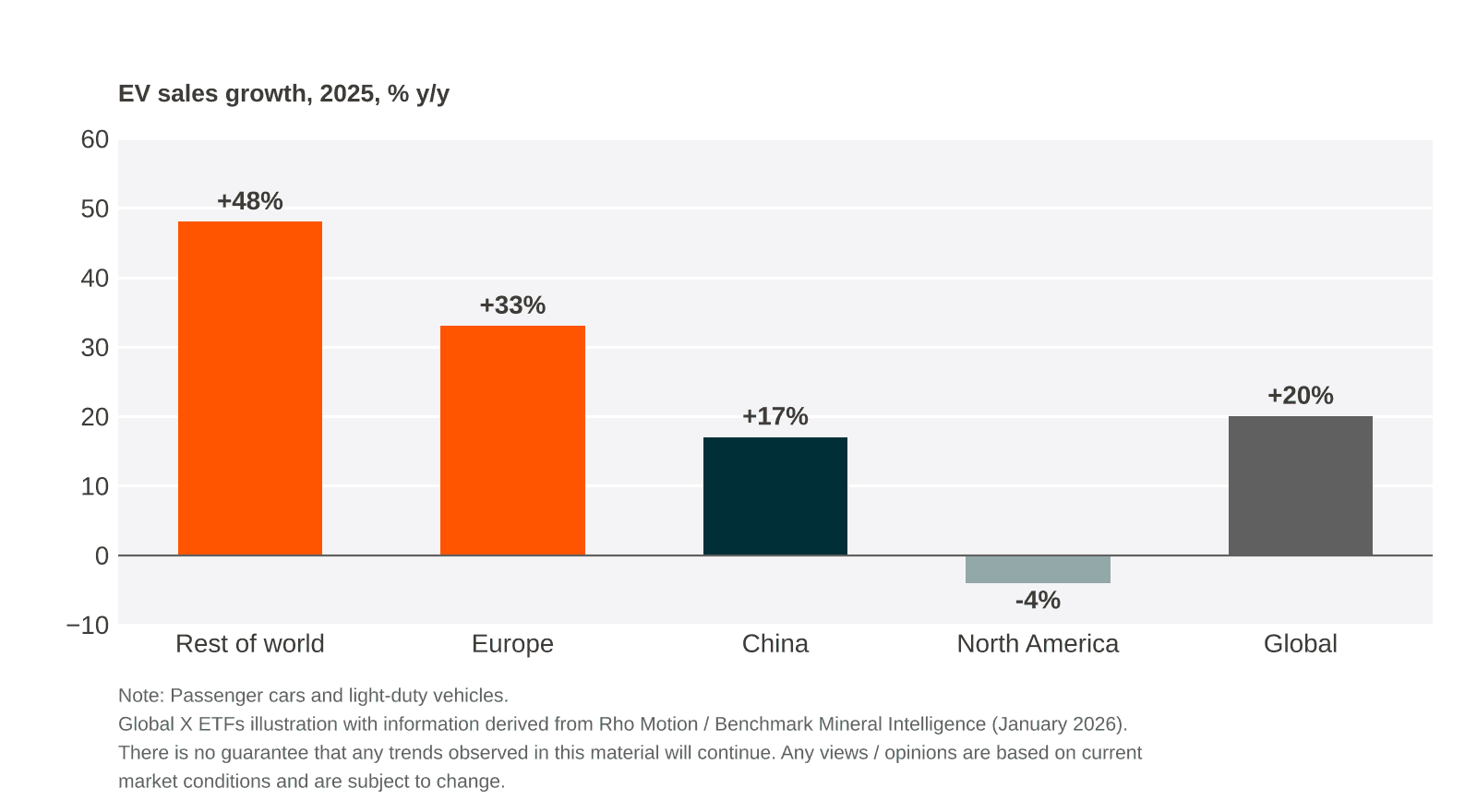
Rest of world and Europe 2025 EV Demand Growth
The battery became grid infrastructure
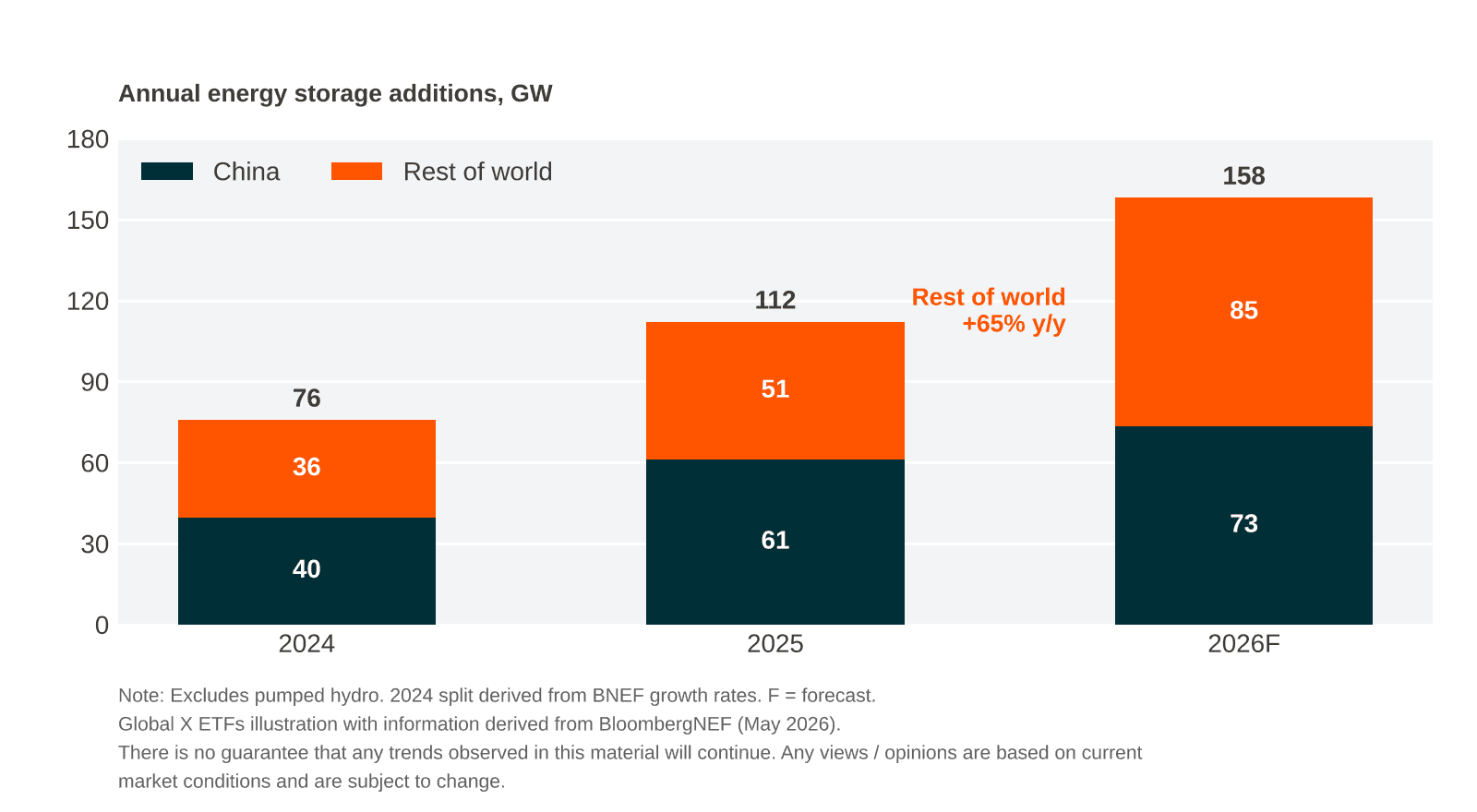
Energy storage is now the incremental buyer of batteries. Global additions excluding pumped hydro are up 48% in 2025, reaching 112GW.¹³ No major power technology has scaled faster.
Storage took four years to go from 10GW to 100GW a year. Solar took eight; wind took fifteen.
Albemarle reported that global lithium consumption grew 45% from January to May 2026, above its own 15% to 40% forecast range, with stationary storage driving the beat and inventories near historic lows.¹⁴ The IEA calls battery storage the fastest-growing power technology today; installed capacity is 11x its 2021 level.¹⁵
Annual Energy Storage Additions*
*Additions excluding pumped hydro
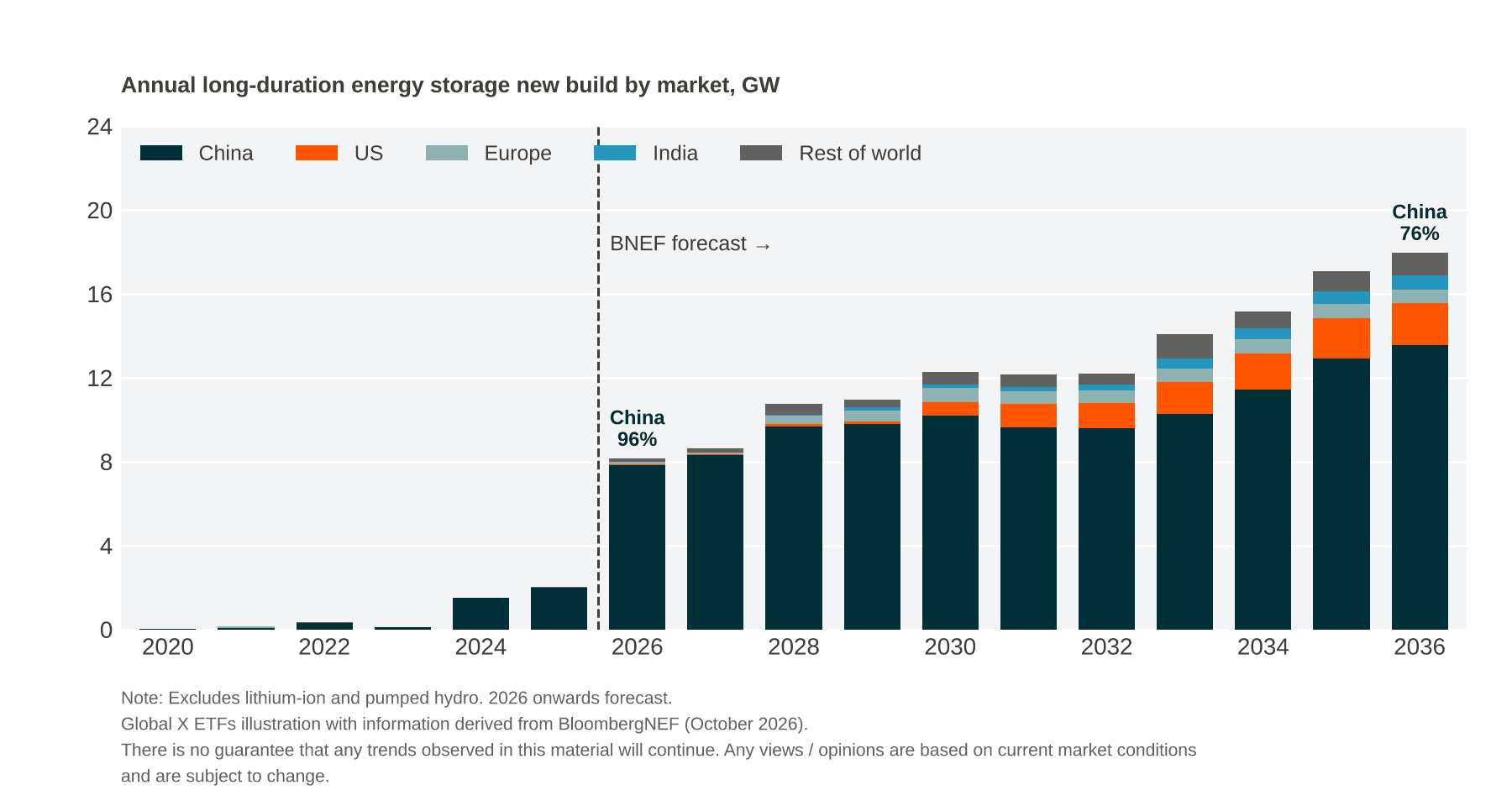
This grid demand emanates from utilities and grid operators against multi-year plans, for assets that run 15-20 years alongside shorter-term projects to fill acute power needs. Currently, China accounts for 96% of long-duration additions, with that number projected to fall to 76% by 2036 as the US, Europe and India scale their projects.¹⁶
Long Duration Storage by Region/Country
Battery innovation only becomes impactful once it can be produced at scale, and that is where the industry’s largest players are indispensable. Commercial viability demands vast manufacturing plants, secure supply chains and a customer base ready to buy in volume.
Increasingly, battery buyers are partnering with their suppliers to diversify battery applications. For example, Ford is entering grid storage under licence from CATL¹⁷, whilst Samsung SDI has partnered with BMW to test solid-state cells in their EVs.¹⁸
LFP (Lithium Iron Phosphate), today’s dominant storage chemistry, became the market leader through manufacturing scale rather than a single breakthrough.¹⁹
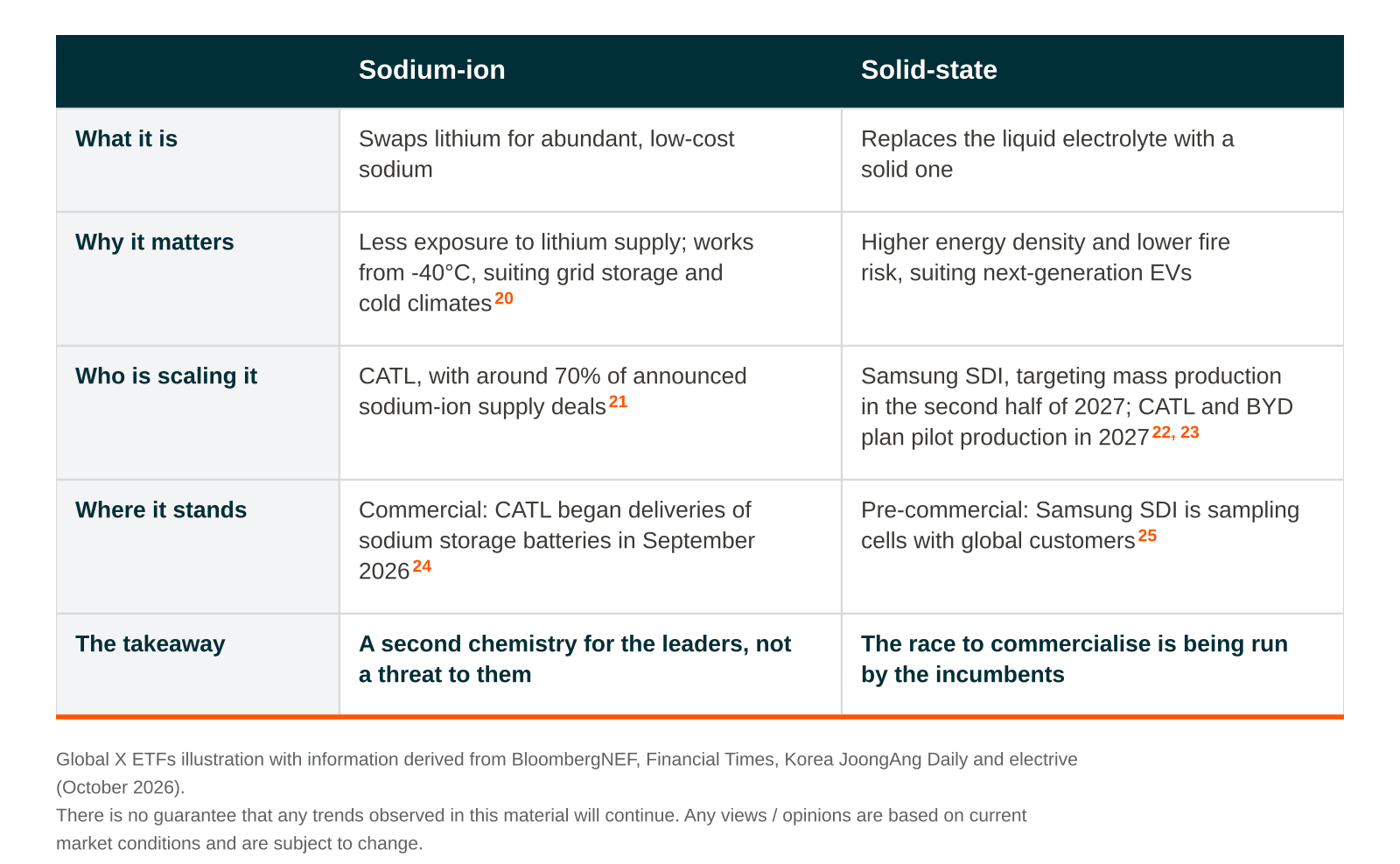
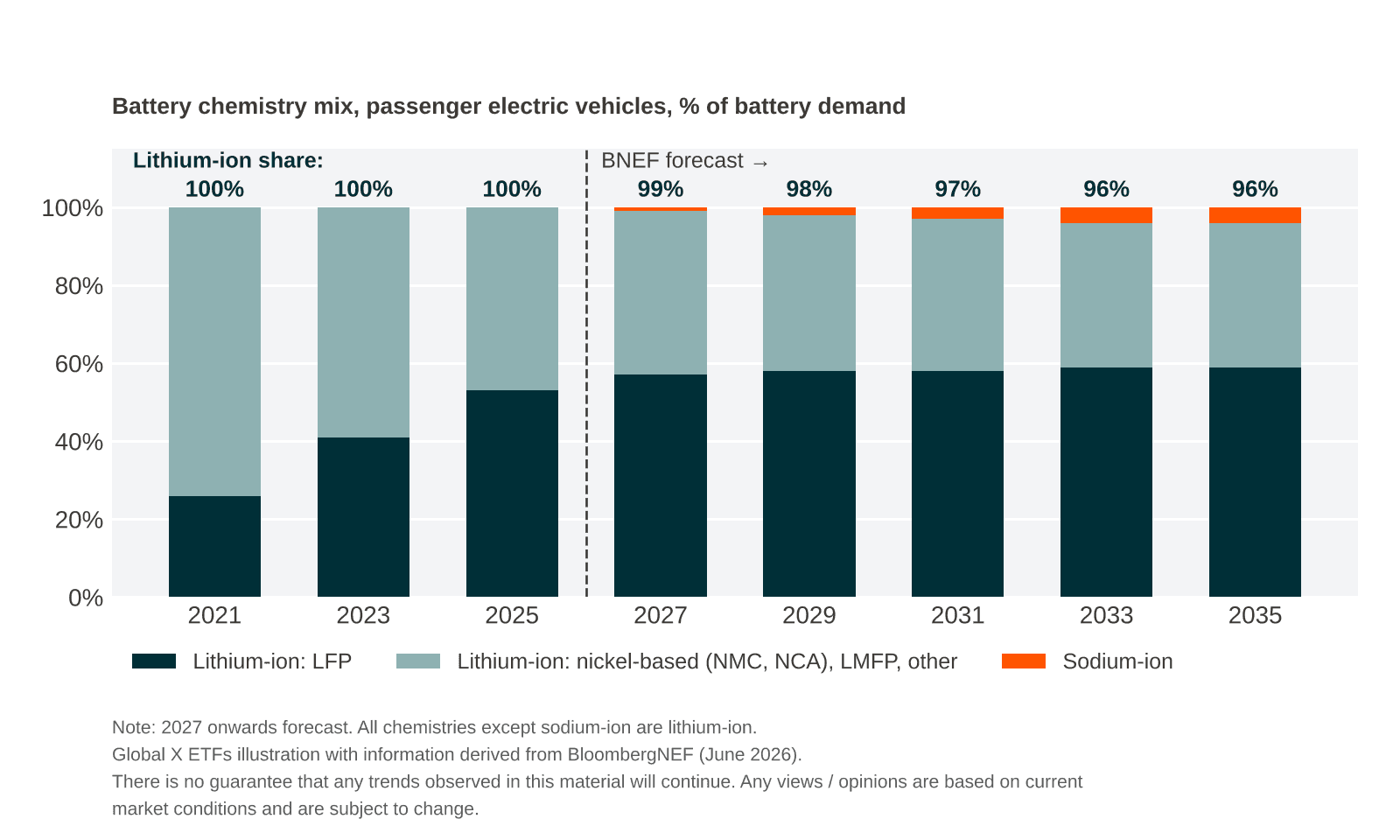
With sodium-ion capacity at about 6% of lithium-ion’s²⁶ and solid-state mass adoption not expected before 2030,²⁷ lithium-ion’s existing scale and supply chain depth leave it unchallenged in most current applications.
Battery Chemistry Mix: Lithium Forecast to be Displaced only at the edges.³⁸
This document is not intended to be, or does not constitute, investment research as defined by the Financial Conduct Authority.
1 IEA (2026) Global EV Outlook 2026: Electric vehicle batteries.
2 IEA (2026) Global Energy Review 2026: Technology, battery storage.
3 Financial Times (Oct 2026) China's bigger, better batteries.
4 BloombergNEF (May 2026) Energy Storage Enters the 100-Gigawatt Era: Three Things to Know.
5 Edison Electric Institute (May 2026) Electric Companies to Invest $1.4T to Support Customers, Power Growth.
6 Rho Motion / Benchmark Mineral Intelligence (Jan 2026) Global EV sales reach 20.7 million units in 2025, growing by 20%.
7 IEA (2026) Global EV Outlook 2026: Electric vehicle batteries.
8 BloombergNEF (May 2026) Energy Storage Enters the 100-Gigawatt Era: Three Things to Know.
9 IEA (2026) Global EV Outlook 2026: Electric vehicle batteries.
10 Ibid
11 IEA (2026) Global EV Outlook 2026: Electric vehicle batteries.
12 Benchmark Mineral Intelligence (Sep 2026) Global EV sales reach 1.8 million units in August 2026.
13 BloombergNEF (May 2026) Energy Storage Enters the 100-Gigawatt Era: Three Things to Know.
14 Albemarle Corporation (Aug 2026) Second quarter 2026 results and earnings call.
15 IEA (2026) Global Energy Review 2026: Technology, battery storage.
16 BloombergNEF (Oct 2026) China's New Five-Year Battery Plan Targets Tech Leadership.
17 Financial Times (Oct 2026) China's bigger, better batteries.
18 Korea JoongAng Daily (Jul 2026) Samsung SDI targets 2027 mass production of solid-state batteries as global clients praise safety.
19 BloombergNEF (Oct 2026) China's New Five-Year Battery Plan Targets Tech Leadership.
20 BloombergNEF (Sep 2026) Sodium-Ion Battery Outlook 2026: Building Momentum.
21 BloombergNEF (Sep 2026) Sodium-Ion Battery Outlook 2026: Building Momentum.
22 electrive (Aug 2026) CATL targets 2027 start for solid-state battery pilot production.
23 Korea JoongAng Daily (Jul 2026) Samsung SDI targets 2027 mass production of solid-state batteries as global clients praise safety.
24 Financial Times (Oct 2026) China's bigger, better batteries.
25 Korea JoongAng Daily (Jul 2026) Samsung SDI targets 2027 mass production of solid-state batteries as global clients praise safety.
26 BloombergNEF (Sep 2026) Sodium-Ion Battery Outlook 2026: Building Momentum.
27 electrive (Aug 2026) CATL targets 2027 start for solid-state battery pilot production.