
Europe

The global space industry is moving from episodic innovation to commercial scale. Falling launch costs, improving rocket reusability, and rising demand for satellite-enabled connectivity and data are changing the economics of space.¹ Once a prestige domain defined by government-led missions, space is now an infrastructure layer for modern communications, geospatial intelligence, defence systems, and emerging compute applications.
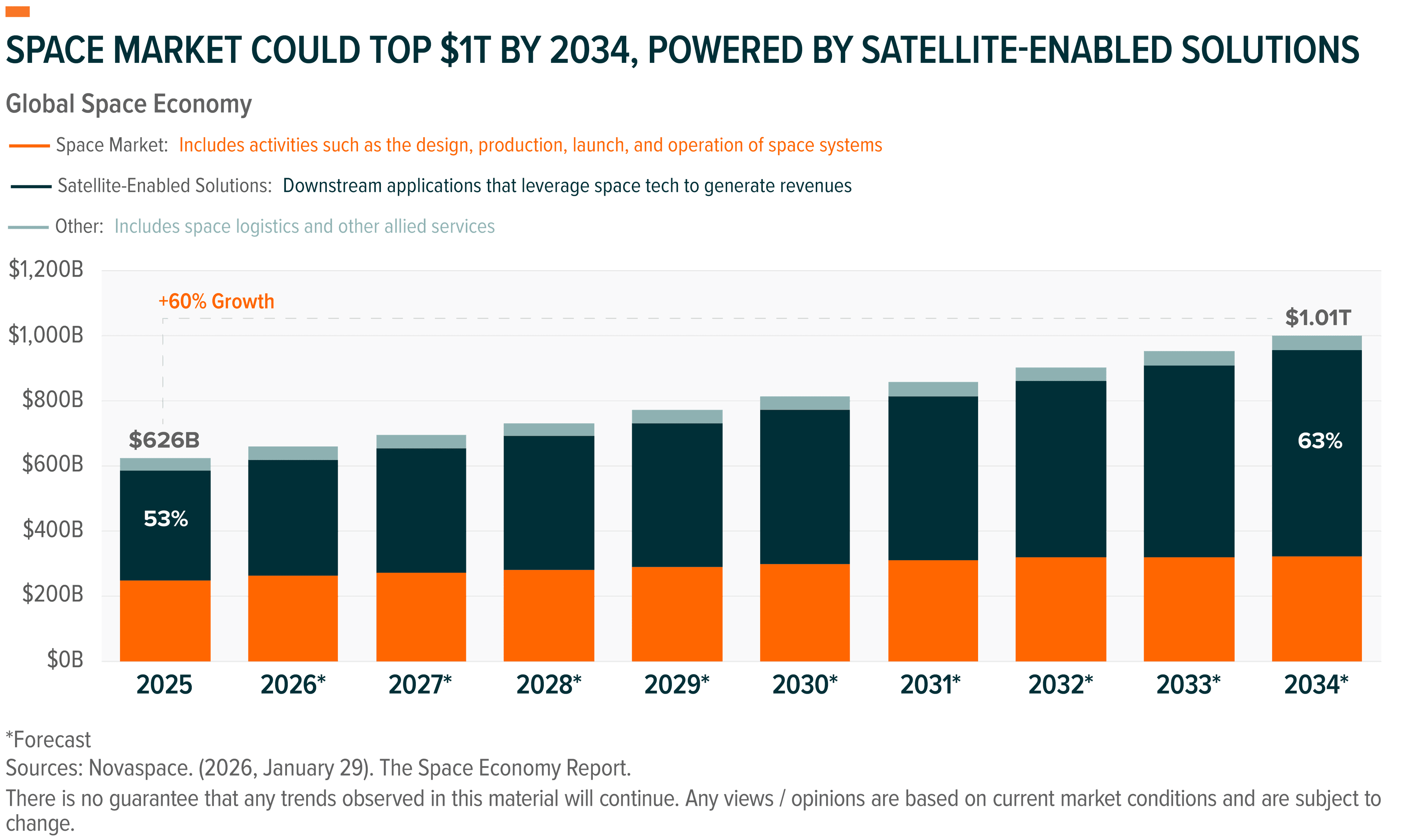
By 2034, the global space market could surpass $1 trillion in annual revenues, up from $626 billion in 2025, with substantial downstream value tied to services built on top of expanding space-based infrastructure.² Segments such as launch services, satellite connectivity, and data services could grow roughly three times faster than the broader space market, with a small group of innovators well positioned to potentially capture a disproportionate share.³
To help investors access this opportunity, we launched the Global X Space Tech UCITS ETF (LUNR). The fund targets companies involved in the space tech value chain, spanning reusable rockets and launch systems, satellite connectivity, and space exploration, along with businesses tied to the commercialisation of space.
Click here to view/download as PDF.
Space represents an unexplored economic frontier. Like railroads in the 19th century, the internet in the 1990s, and AI in the 2020s, space infrastructure could define the 2030s, laying a critical foundation for the next phase of the global economy.
When the modern space age began nearly 60 years ago, access to space was the exclusive domain of nation-states with vast budgets, proprietary technology, and long development timelines. Those dynamics began to change in the 2010s as private capital entered the launch market and commercial satellite operators demonstrated viable business models. Today, commercial activity accounts for roughly 70% of global orbital launches, up from just 25% a decade ago.⁵,⁶
Two groups of companies are driving the industry towards commercialisation at scale. One group is transforming launch services, turning access to space from bespoke aerospace engineering into repeatable logistics. The other is monetising that infrastructure through satellites and the downstream services and applications built on top of them. Examples include SpaceX and Rocket Lab respectively. Satellite-enabled solutions could account for roughly 63% of total space revenues by 2034, reflecting higher constellation density and the expansion of new service layers built on orbital infrastructure, such as broadband internet.⁷
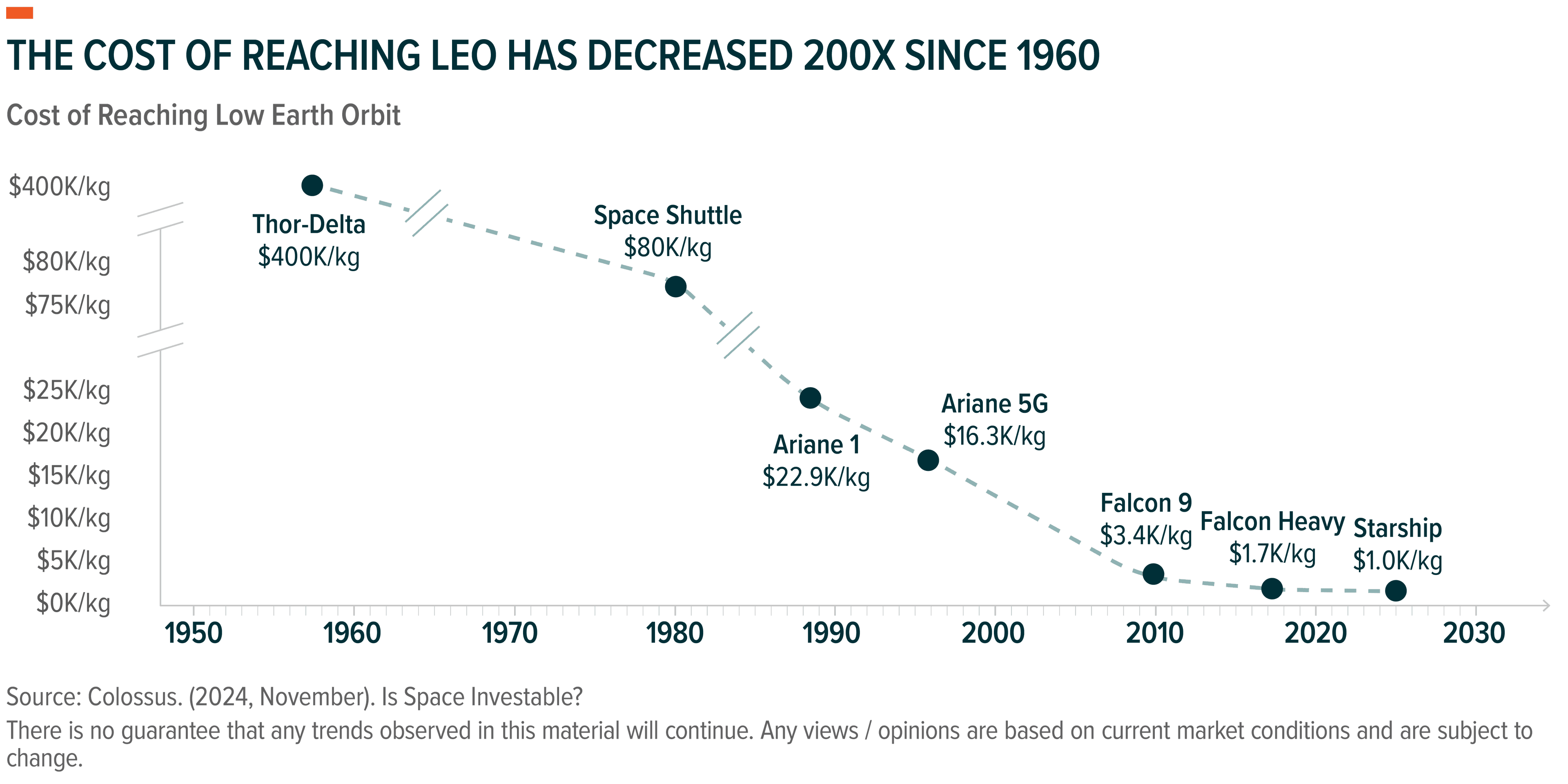
The largest structural change in space tech over the past two decades is the decline in cost of payload delivery to Low Earth Orbit (LEO), the altitude range up to 2,000 kilometres, where most commercial satellites operate.⁸,⁹ NASA’s Space Shuttle, which flew its last mission in 2011, cost $54,500 per kilogram to LEO. Today, SpaceX’s Falcon 9, the workhorse of the modern launch market, costs roughly $2,720 per kilogram. SpaceX’s current capabilities sheet lists Falcon 9 pricing at $74 million per launch, with payload capacity to LEO of up to roughly 22,000 kilograms in expendable configuration.¹⁰
Exact mission economics vary based on payload, but the direction is clear: launch is dramatically cheaper than it used to be and far more repeatable due to reusability and commercial-grade iteration. Recovering and re-flying first-stage boosters transforms launch from a one-time expenditure into a repeatable operating model. With a 97% success rate on reused boosters and fairing halves, SpaceX has substantially reduced hardware amortisation costs and set a new pricing standard across the industry.¹¹
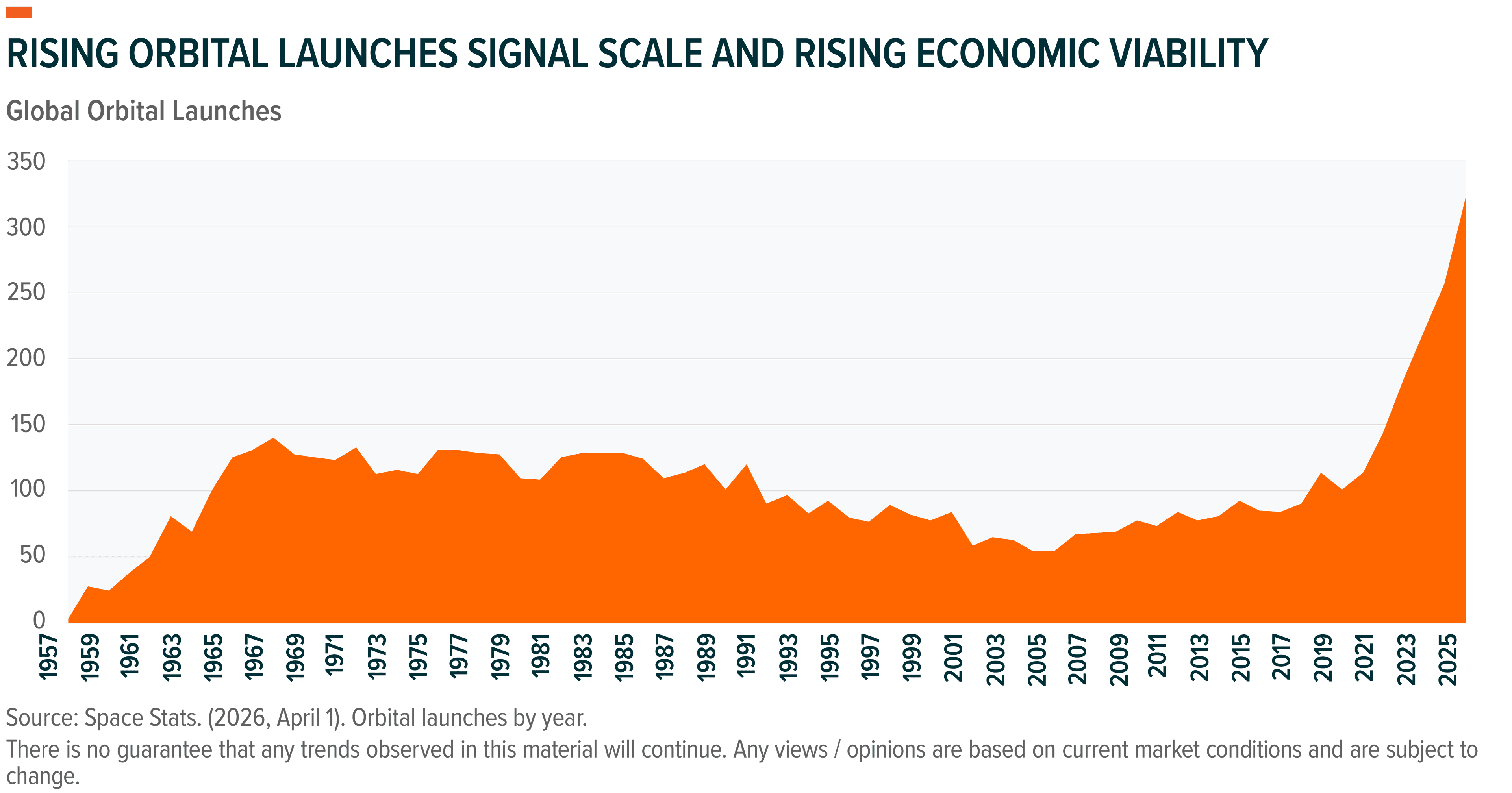
With better economics, global orbital launch attempts jumped to roughly 325 in 2025, compared to 85 in 2016. The United States alone accounted for nearly 179 successful launches in 2025, representing about 52% of global activity.¹²
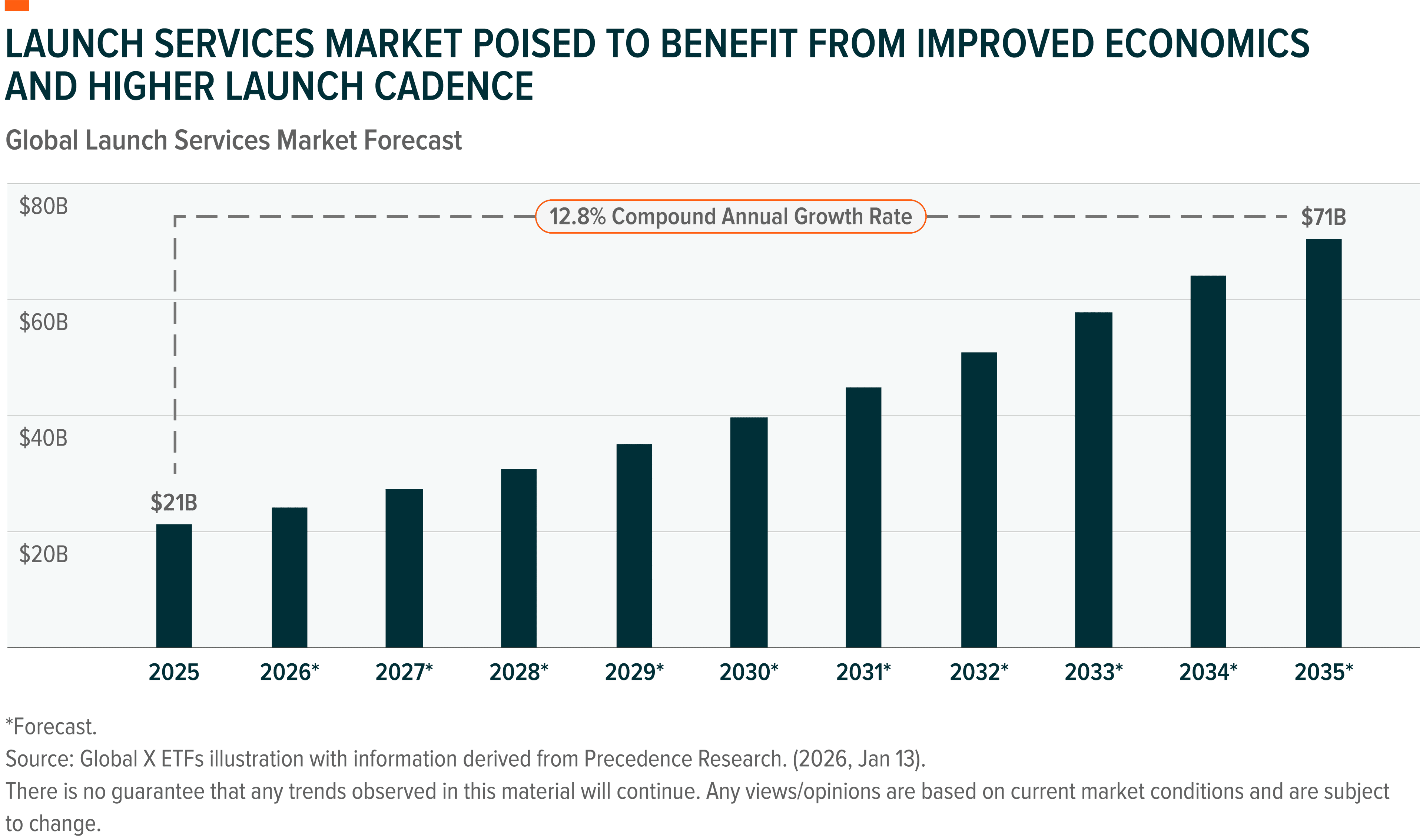
Rising launch activity is reshaping the industry’s planning cycle and its utility by enabling satellite operators to replenish constellations faster, governments to build more resilient architectures, and suppliers to serve a market with more predictable deployment schedules. The commercial launch market is projected to grow to nearly $70 billion by 2035, representing a 13.4% compound annual growth rate (CAGR) from 2025.¹³ The continued deployment of broadband constellations and the buildout of resilient defence architectures that require tactically responsive and assured access to orbit are likely to drive this growth.¹⁴
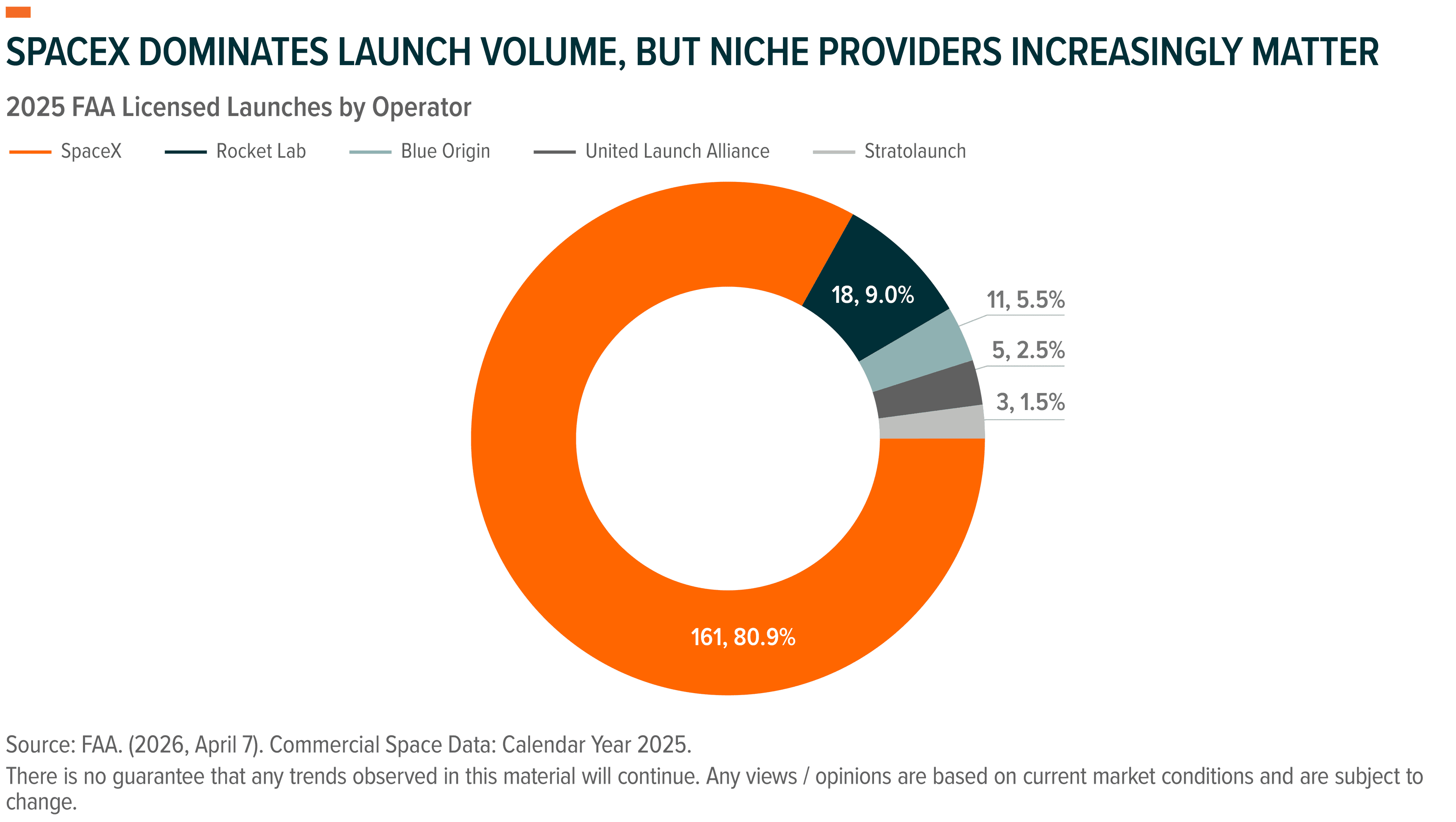
The launch market is also broadening beyond SpaceX. Rocket Lab’s Electron has established a niche in dedicated small satellite launches, where schedule control and mission specificity can matter more than the lowest possible cost per kilogram. As of March 2026, Rocket Lab had completed nearly 85 launches.¹⁵ In 2025, the company accounted for roughly 8% of Federal Aviation Administration (FAA)-licensed launches.¹⁶ This growing diversity and depth within the launch ecosystem supports more business models across the broader space stack.
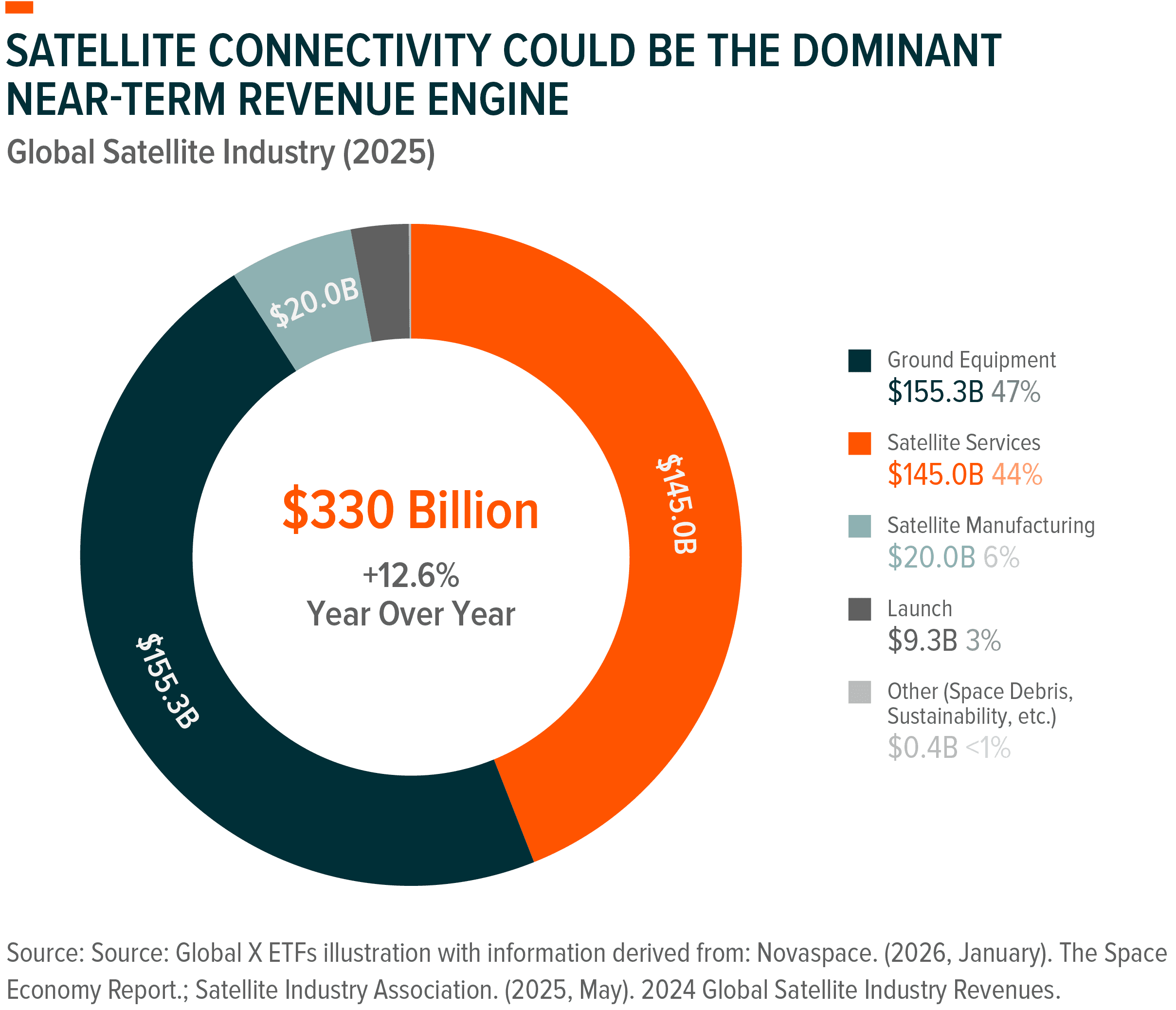
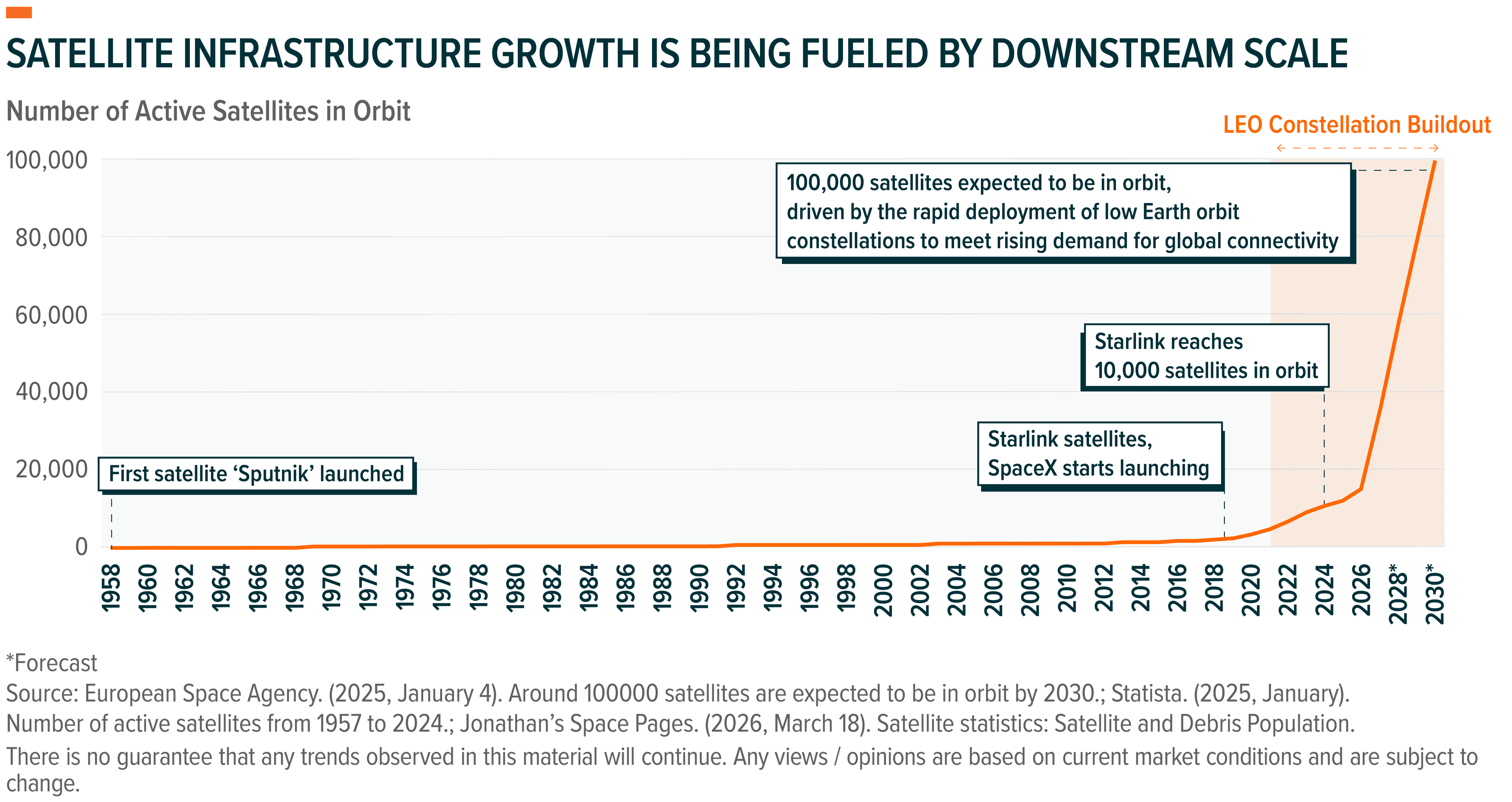
If launch is the enabler, satellites are the monetisation layer. Over 50% of today’s space market is tied to satellites, spanning infrastructure, connectivity, and downstream applications.¹⁷ Now, the market is evolving as the opportunity shifts from individual satellites to dense networks in LEO that can deliver broadband, navigation, Earth observation, and secure communications. The shift transforms orbit from a collection of one-off assets into a persistent infrastructure layer, further boosting satellites’ share of the space industry.
The installed base is rising quickly. Active satellites in orbit have grown from nearly 1,000 in 2010 to more than 12,000 in 2025.¹⁸ Estimates suggest that could approach 100,000 by 2030 as operators such as Starlink and Amazon Leo (formerly Project Kuiper) continue their deployment programs to scale LEO satellite broadband.¹⁹ SpaceX’s Starlink reached 10,000 satellites in orbit in 2025, supporting roughly 9.25 million active internet customers across 155 regions by early 2026.²⁰
As networks like Starlink scale, satellite infrastructure begins to resemble a recurring-revenue service model rather than a project-based aerospace business with irregular cash flows. This transformation could be one of the most important changes underway in space today and central to its investment case. The satellite broadband market is projected to grow at a 16% CAGR to $100 billion by 2035, up from an estimated $22 billion in 2025, driven by household connectivity, enterprise backhaul, mobility, emergency response, and military use cases.²¹ AST SpaceMobile for example, achieved FCC authorisation for commercial service in the U.S. and demonstrated 98.9 Mbps peak data speeds in orbit, while expanding partnerships across 50+ global mobile network operators serving nearly 3 billion subscribers.²²
Beyond broadband, the satellite services market extends into a downstream application layer that includes climate monitoring, logistics visibility, precision agriculture, and defence intelligence. This roughly $145 billion market could still be in its early stages, as constellation density rises and new service layers scale on top of that infrastructure.²³
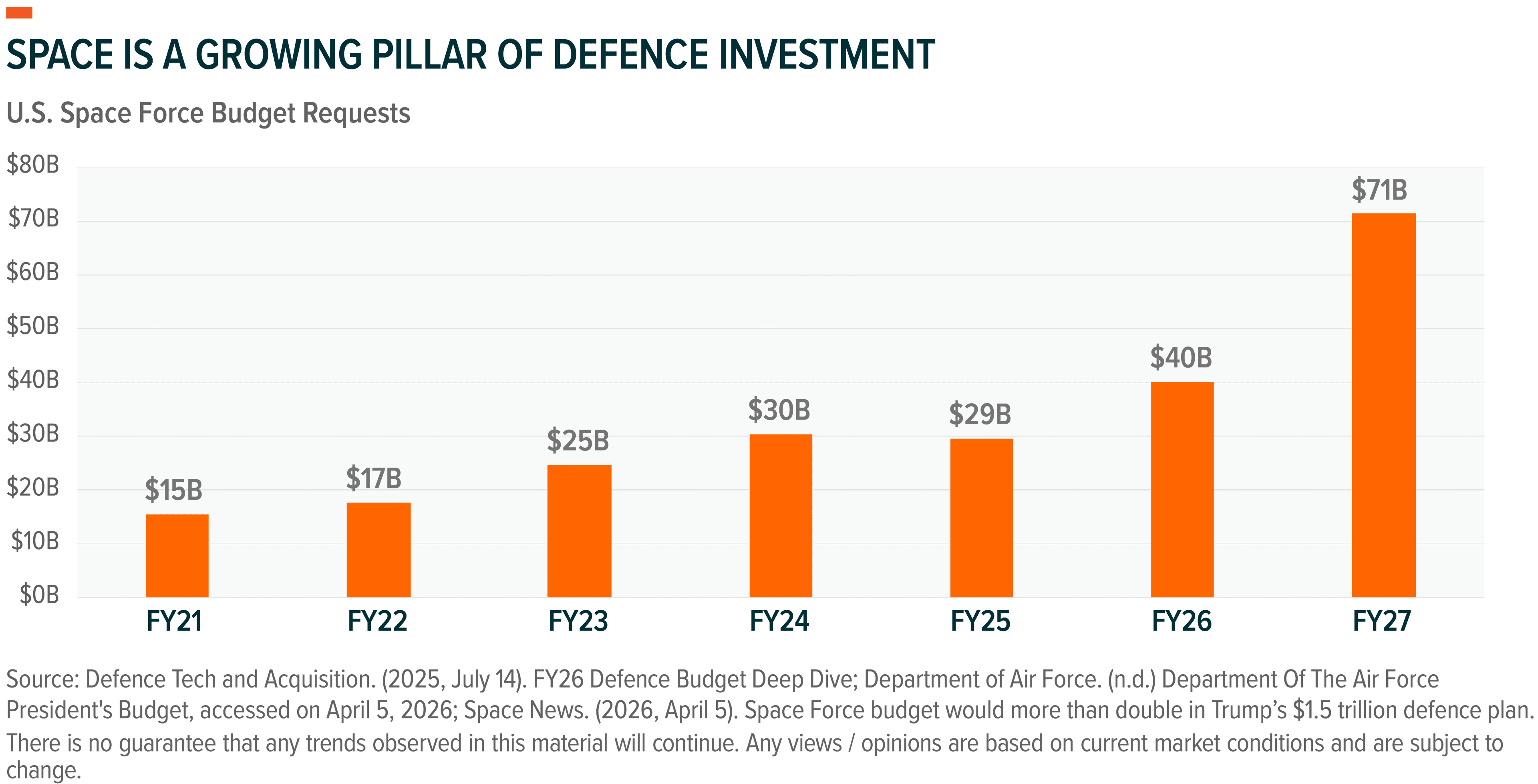
Governments worldwide spent $137 billion on space in 2025. Roughly $73 billion of that spending was defence-related, accounting for about 2% of total global military spending.²⁴ In the United States, investment is accelerating sharply with space recognised as a primary national security initiative. The U.S. Space Force’s fiscal 2027 budget request of nearly $71 billion is double its fiscal 2025 budget.²⁵
Space is increasingly central to missile warning, communications, intelligence, surveillance, and reconnaissance, and the broader architecture of resilient national defence. Assured access to orbit, space-based sensing, and the ability to rapidly reconstitute satellite capabilities in contested environments are strategic imperatives for modern military planning. Proposed programs like the Golden Dome missile defence initiative, which reports suggest could require nearly $185 billion to complete, point to even greater investment increases in space-based sensing and defence infrastructure.²⁶
Programs like these matter because the predictability and visibility of defence spending can help stabilise the space tech market during potential periods when commercial capital becomes more selective.
Space-based data centres and other power-intensive computing workloads represent a longer-duration optionality embedded in the space technology value chain that is beginning to attract significant capital and engineering attention.²⁷
The economics of orbital computing remain challenging, as launch costs still need to decline materially, below roughly $200 per kilogram to LEO, for orbital compute to be competitive with terrestrial alternatives.²⁸ But the directional logic is compelling. Orbital environments offer access to abundant solar energy and ease cooling and water use constraints while bypassing many of the regulatory, permitting, land-use, and power procurement bottlenecks on Earth.
The Global X Space Tech UCITS ETF (LUNR) is designed to provide investors with focused exposure to space technology companies building and enabling the commercialisation of space. The fund is designed to track the Mirae Asset Space Tech UCITS Index.
Leveraging Global X’s long-standing thematic ETF expertise, LUNR targets the space tech value chain, which includes companies directly tied to launch systems, satellites, space-enabled data and communications, and the components and software that make those systems work. These companies comprise four segments within the Mirae Asset Space Tech UCITS Index:
— Rocket Launch and Reusable Rockets: companies providing launch systems and reusability technologies that can reduce the cost of access to space
— Space Tech & Components: companies supplying mission-critical hardware, propulsion, software, analytics, and specialised components that support modern space operations
— Satellite Telecommunications & Data Services: companies enabling connectivity, navigation, imaging, and secure communications through satellite systems and related infrastructure
— Space Transportation, Tourism, and Exploration: companies commercializing human spaceflight, orbital access, and related exploration services
To be eligible for inclusion, companies must derive at least 50% of their revenues from space tech-related activities, as defined by the four segments. This criterion keeps the portfolio centred on businesses where space is a core driver of fundamentals, rather than a peripheral line-item or a future option.
The index uses a modified market-cap weighted methodology, which helps to maintain exposure to established leaders while also capturing smaller, high-growth companies potentially shaping the next phase of the market. The result is a fund that seeks to capture today’s more commercially proven space tech segments, while still retaining exposure to emerging parts of the value chain.
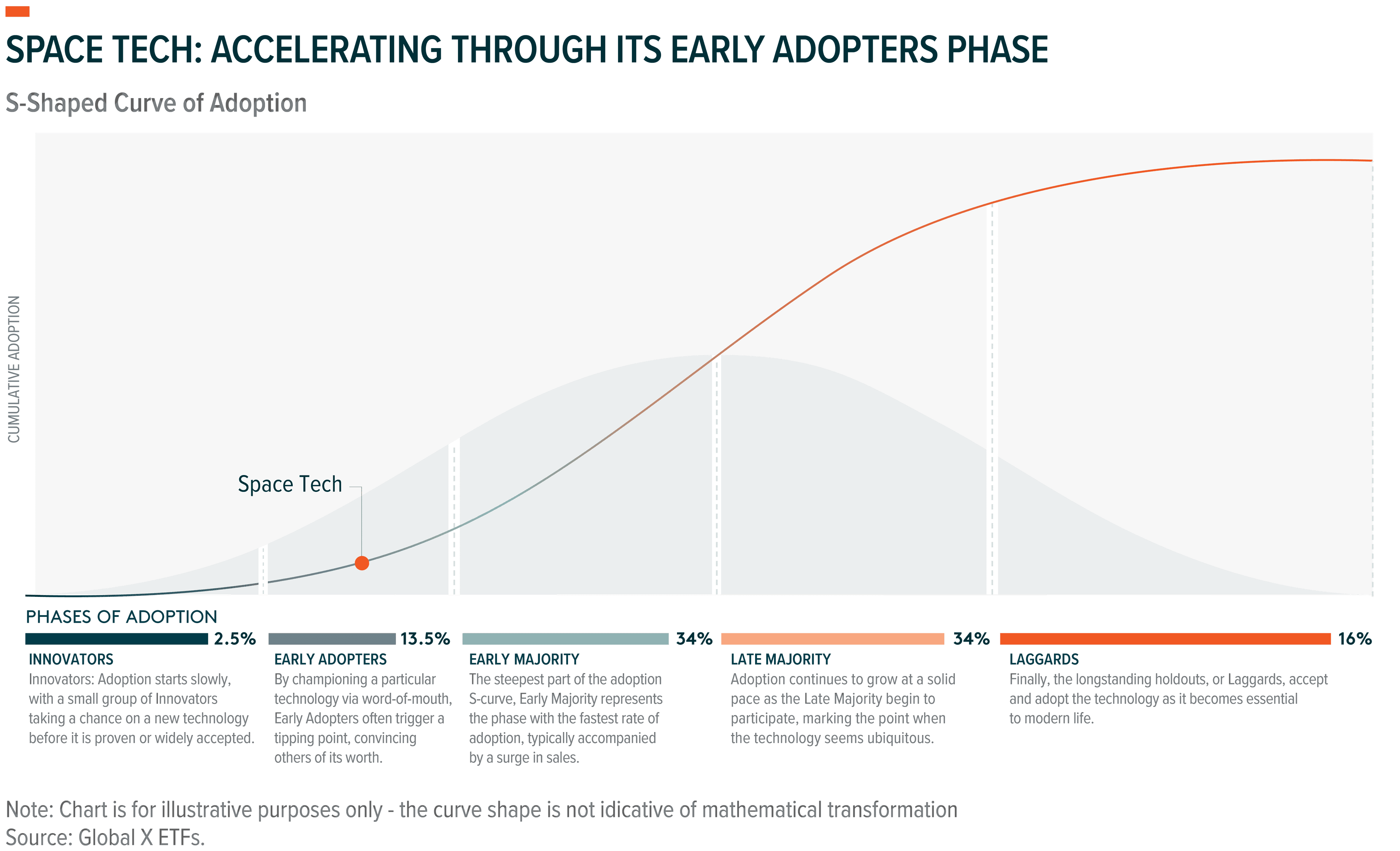
The global space industry is undergoing a structural transformation driven by converging forces: the economics of reusable launch technology, the scaling monetisation of satellite-enabled connectivity and data services, and the strategic imperative of national defence in orbit. Space tech’s near-term investment case is anchored in commercially proven segments, such as satellite internet, while the longer-duration optionality of avenues such as orbital computing adds a growth dimension that remains underappreciated.
For investors, LUNR offers a differentiated, pure-play approach to one of the most structurally compelling and long-duration emerging themes in the market today.
This document is not intended to be, or does not constitute, investment research as defined by the Financial Conduct Authority.
1. McKinsey. (2024, April 8). Space: The $1.8 trillion opportunity for global economic growth.
2. Novaspace. (2026, January). The Space Economy Report.
3. Global X ETFs estimates with info derived from: Novaspace. (2026, January). The Space Economy Report.; Satellite Industry Association. (2025, May). 2024 Global Satellite Industry Revenues.
4. Ibid.
5. Space Stats. (2026, Feb 27). Orbital launches per year.
6. FAA. (2015). Commercial Space Transportation 2014 Year in Review.
7. Novaspace. (2026, January). The Space Economy Report.
8. NASA (2020, February 21). The Recent Large Reduction in Space Launch Cost.
9. NewsBytes. (2026, January 23). SpaceX's Falcon 9: Making space launches way more affordable.
10. SpaceX. (2025, March). Falcon User’s Guide.
11. Ibid.
12. Space Stats. (2026, February 27). Orbital launches per year.
13. Global X ETFs illustration with information derived from: Allied Market Research. (2025, January). Space Launch Services Market Research, 2033.; EMR. (2026, January). Space Launch Services Market Size, Share and Forecast Trends - Growth Analysis and Outlook Report (2026-2035).; Precedence Research. (2025, May 28). Space Launch Services Market Revenue to Attain USD 57.94 Bn by 2033.
14. Satellite Industry Association. (2026, May). Affordability and Productivity Drive Historic Satellite Industry Growth: Satellite Industry Association Releases the 29th Annual State of the Satellite Industry Report.
15. Rocket Lab. (2026, March 28). Rocket Lab Successfully Launches 85th Mission and First Dedicated Launch for European Space Agency.
16. Space News. (2025, December 21). Rocket Lab wraps up record launch year.
17. Novaspace. (2026, January). The Space Economy Report.
18. Kandula et al (2026, January 5). Report on LEO satellite impacts on ground-based optical astronomy for the Rubin Observatory LSST.
19. European Space Agency. (2025, January 4). Around 100000 satellites are expected to be in orbit by 2030.; Statista. (2025, January). Number of active satellites from 1957 to 2024.; Jonathan’s Space Pages. (2026, March 18). Satellite statistics: Satellite and Debris Population.
20. Scientific American. (2026, March 17). SpaceX now has more than 10,000 Starlink satellites in orbit.
21. Goldman Sachs. (2025, March 5). The global satellite market is forecast to become seven times bigger.
22. SEC Filing. AST SpaceMobile provides Business Update and First Quarter 2026 Results. 11 May 2026.
23. Global X ETFs estimates with info derived from: Novaspace. (2026, January). The Space Economy Report.
24. Novaspace. (2026, Jan 20). Global Space Spending Reaches $137B, Marking a Defense‑Led Era.
25. Space News. (2026, April 5). Space Force budget would more than double in Trump’s $1.5 trillion defense plan.
26. Reuters. (2026, March 17). US expands Golden Dome cost estimate to $185 billion, enlists top defense firms.
27. Wired. (2025, September 20). Big Tech Dreams of Putting Data Centers in Space.
28. Ibid.