
Europe

Marketing Communication. Capital at risk. For Professional Investors Only. Please read fund legal documentation before making any final investment decisions.
Robots that can perceive their surroundings, interpret instructions and act in the physical world are moving from controlled demonstrations into factories, hospitals and logistics networks, a shift increasingly described as physical AI. What separates this from the AI most people already use, like a chatbot? Physical AI adds perception, decision-making and physical action, operating together in a real environment, capabilities a purely digital assistant does not require. Those capabilities are already showing up in a growing number of installed systems,¹ completed procedures,² operating fleets and agreements tied to specific production environments, including several multi-year commitments.³,⁴ These deployments generate near-term hardware revenue while potentially creating longer-term demand for software, servicing, components and computing infrastructure.
Global industrial robot installations reached 542,000 units in 2024, the second-highest annual figure on record and more than double the total from a decade earlier.¹³ The number of robots operating in factories rose 9% to 4.7 million, while annual installations remained above 500,000 for a fourth consecutive year.¹⁴ This provides an established demand base for robot manufacturers, machine-vision specialists and industrial software providers.
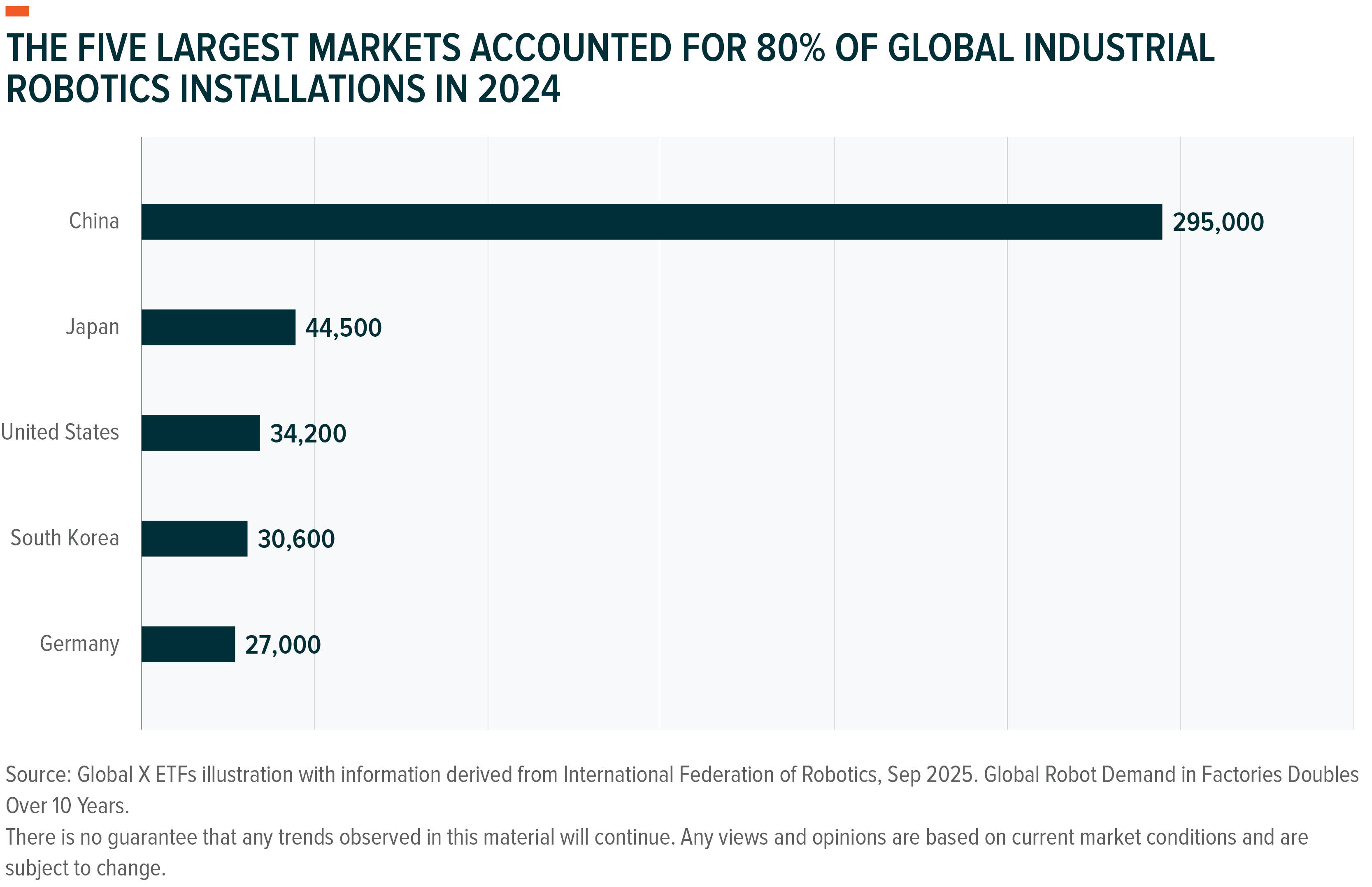
The market is also highly concentrated. China installed 295,000 industrial robots in 2024, compared with 44,500 in Japan, 34,200 in the United States, 30,600 in South Korea and 27,000 in Germany.¹⁵ Together, the five largest markets represented 80% of global installations.¹⁶ China's scale creates a large addressable market, and its domestic suppliers are becoming a growth story in their own right: they captured 57% of the Chinese market in 2024, up from roughly 28% a decade earlier, a sign of how deep and self-sustaining robot adoption has become in the world's largest market.¹⁷ However, raw counts only tell part of the story. By robot density, Japan and Germany rank third and fourth worldwide at 446 and 449 installs per 10,000 manufacturing employees respectively, demonstrating their depth of automation.¹⁸
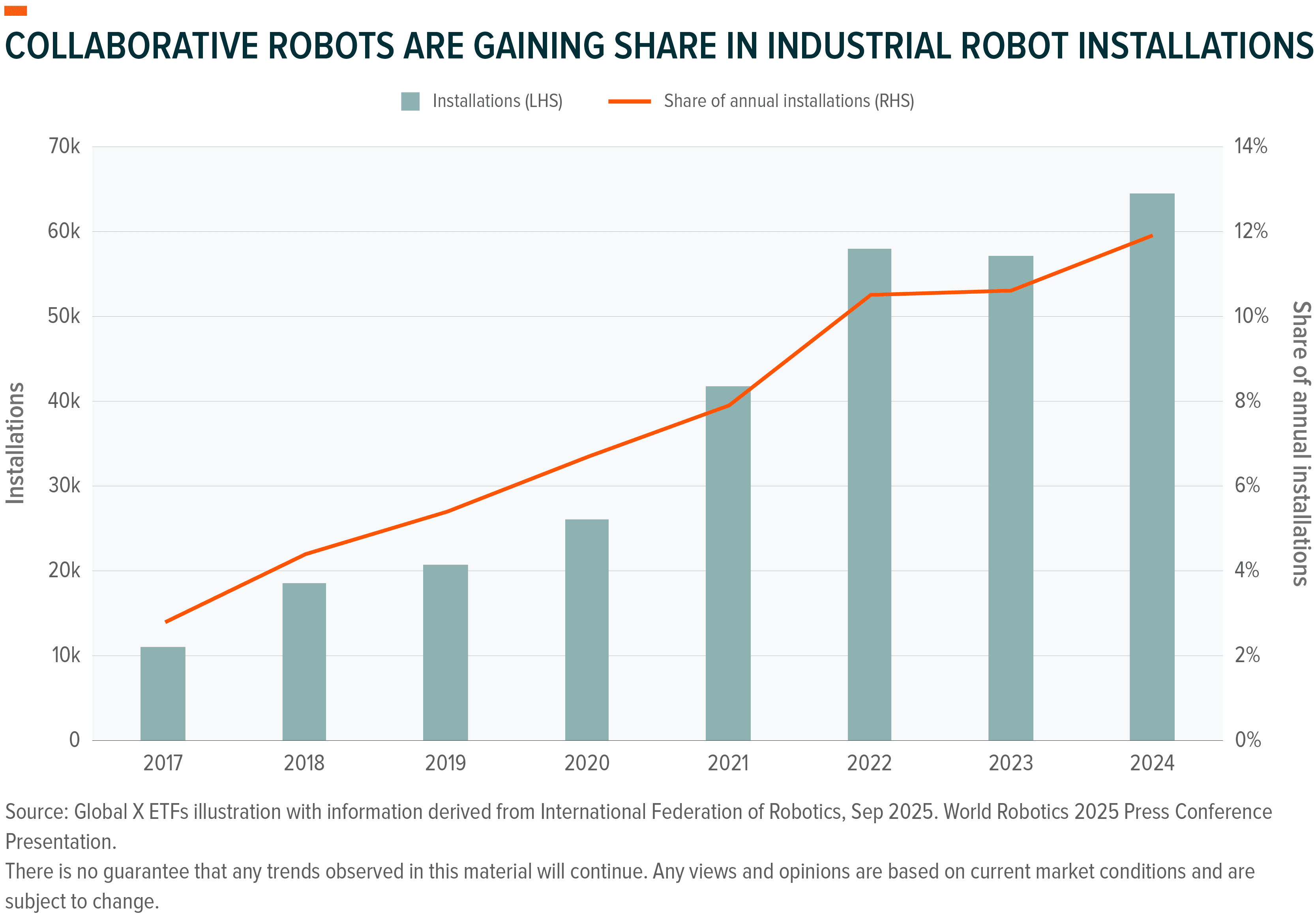
Collaborative robots (cobots) show that the form of automation is changing. Unlike conventional industrial robots, cobots are force-limited and certified to the ISO/TS 15066 standard, letting them share a workspace with people without fixed guarding.¹⁹ Cobot installations rose from 11,107 in 2017 to 64,542 in 2024, with their share of industrial robot installations rising every year across the period, from 2.8% to 11.9%.²⁰ If that trajectory continues, cobots would become a larger share of unit volume over time without a new catalyst. The International Federation of Robotics (IFR) frames cobots' ease of programming and compact footprint as a way of extending automation to smaller manufacturers that have not previously invested in robots, enabling the “democratisation of automation”.²¹ This could broaden the customer base and facilitate a greater role for sensors, vision and software enabling safe, flexible operation.
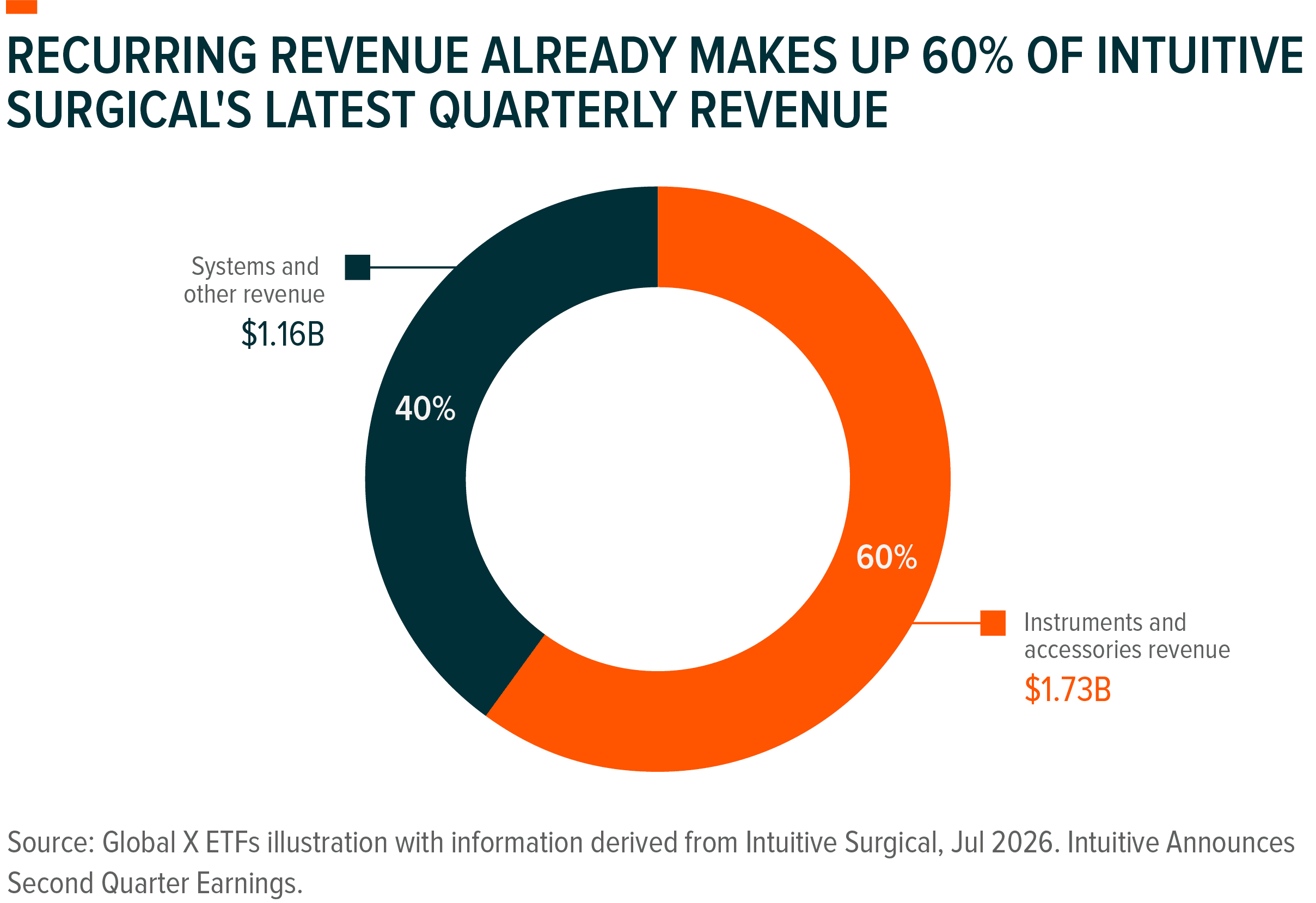
Healthcare provides some of the clearest evidence that robotics can create recurring revenue after the initial sale.²² Intuitive Surgical's model is structurally closer to razor-and-blade than a one-off equipment sale. The da Vinci system establishes the installed base, while instruments and accessories used in procedures, together with service contracts, generate the recurring revenue that follows.²³ In the second quarter of 2026, the company placed 468 da Vinci systems, up from 395 a year earlier, expanding its installed base 12% to 11,710 systems.²⁴ Procedure volume grew approximately 15%, and instruments and accessories revenue rose 18% to $1.73 billion, roughly 60% of the company's $2.89 billion in total revenue.²⁵ Each new system compounds into a stream of per-procedure revenue for as long as it stays in service, a pattern the wider market echoes, with IFR-surveyed manufacturers reporting medical robots as their fastest-growing service-robot category in 2024, up 91%.²⁶
Warehousing illustrates a different business model within the same theme. Where Intuitive Surgical earns a recurring stream from procedures, Amazon's robots are an internal capital investment where the return shows up via greater operational efficiency, rather than a separate revenue line. Amazon deployed its one-millionth robot in 2025 and introduced DeepFleet to coordinate its mobile robots and improve travel efficiency by 10%.²⁷ Separately, it has deployed Vulcan, a robot with force and touch sensing for difficult-to-reach picks.²⁸ The opportunity here for robotics suppliers could sit in the software and sensor upgrade cycle, instead of a per-unit sale.
Industrial robotics appears to be following a third path, evolving from predominantly point-in-time equipment sales toward a hardware-plus-software-and-services model, with recurring offerings such as software, cloud applications, upgrades and lifecycle services layered onto the installed robot base.²⁹ FANUC’s collaboration with Google combines its robots with Gemini Enterprise, letting operators issue natural-language instructions rather than write custom code per task, shortening integration time and lowering the cost of redeploying the same hardware.³⁰ FANUC had shipped more than 1,000 robots for physical-AI-related applications by May 2026.³¹ While this is small relative to its installed base, it is evidence of an emerging attach-rate opportunity, where software revenue layers onto hardware already sold.
While the humanoids category remains earlier-stage than industrial robots, mobile robots or surgical systems,³² there are two key questions emerging here. Firstly, whether humanoids can run reliably in a live production environment, and secondly, whether they can perform a genuinely wide range of tasks.
BMW supplies the clearest evidence of reliability at scale. Figure 02 supported production of more than 30,000 BMW X3 vehicles over an 11-month deployment at its Spartanburg plant, moving more than 90,000 components and covering approximately 1.2 million steps in around 1,250 operating hours.³³ This is an example of real output sustained over real time rather than a one-off demonstration. BMW has since expanded the programme to Figure 03 for logistics-sequencing work at the same site, widening the robot's role with an existing partner.³⁴
Boston Dynamics appears to offer a clearer signal on the second question. In May 2026, its electric Atlas platform, unveiled in production form at CES 2026, demonstrated real generalisation. A lifting behaviour trained on loads of roughly 50 pounds handled more than 100 pounds in internal testing, unassisted, an instance of what roboticists call zero-shot sim-to-real transfer. All 2026 production is already committed to Hyundai's own Robotics Metaplant Application Center and Google DeepMind, with a stated target of 30,000 units a year from 2028.³⁵
This generalisation capability is also underpinned by partnerships. DeepMind's Gemini Robotics models are built to transfer learned behaviour across robots of all different shapes and sizes, and DeepMind has signed up partners accordingly, Apptronik from March 2025,³⁶ Boston Dynamics from January 2026,³⁷ and Agile Robots from March 2026.³⁸ The prospect of a common single AI layer operating across multiple competing humanoid platforms could create a different source of value from investing in any single hardware layer.
Schaeffler, an automotive industry group, adds a supply-chain data point. in January 2026 it announced plans to integrate humanoids into its own production network, and following an agreement in May, added a seven-digit number of joint actuators under contract through 2031.³⁹,⁴⁰ This demonstrates a way for components businesses to capture value from the theme without needing any single robot platform to win. Humanoid, the customer on the other side of that contract, has its own evidence. Its HMND 01 wheeled humanoid completed a proof-of-concept for autonomous logistics at a Siemens factory in Erlangen, Germany, with simulation-first development compressing roughly two years of hardware work into just seven months.⁴¹
NVIDIA is building an end-to-end physical AI stack, with Cosmos providing world foundation models and tools for synthetic data generation and model generation, and Jetson supplying edge-computing hardware for running inference and robot-control models locally, including on the robot itself.⁴²,⁴³ In July 2026, Japanese groups including FANUC and Yaskawa Electric said they were developing applications on these platforms.⁴⁴ That same month, Japan's government and NVIDIA launched a national Physical AI Initiative to build open foundation models for robotics, alongside an existing national AI infrastructure project using 27,500 NVIDIA Rubin GPUs,⁴⁵ while the Japanese government has set a public target of representing 30% of the global AI-robotics market by 2040.⁴⁶
Germany is building a parallel foundation: its Industrial AI Cloud, built by Deutsche Telekom on NVIDIA infrastructure, is what NVIDIA calls a secure, sovereign platform for AI and robotics across Europe, already used by Siemens and SAP.⁴⁷ Munich-based Microagi shows the same push privately, with the year-old startup partnering with Google Cloud and NVIDIA for compute to train models already used by Unitree and UBTECH, and its founder warning that Europe has “a narrow window to build sovereign embodied AI infrastructure.”⁴⁸ These initiatives could shorten development cycles by giving manufacturers access to simulation and shared models.
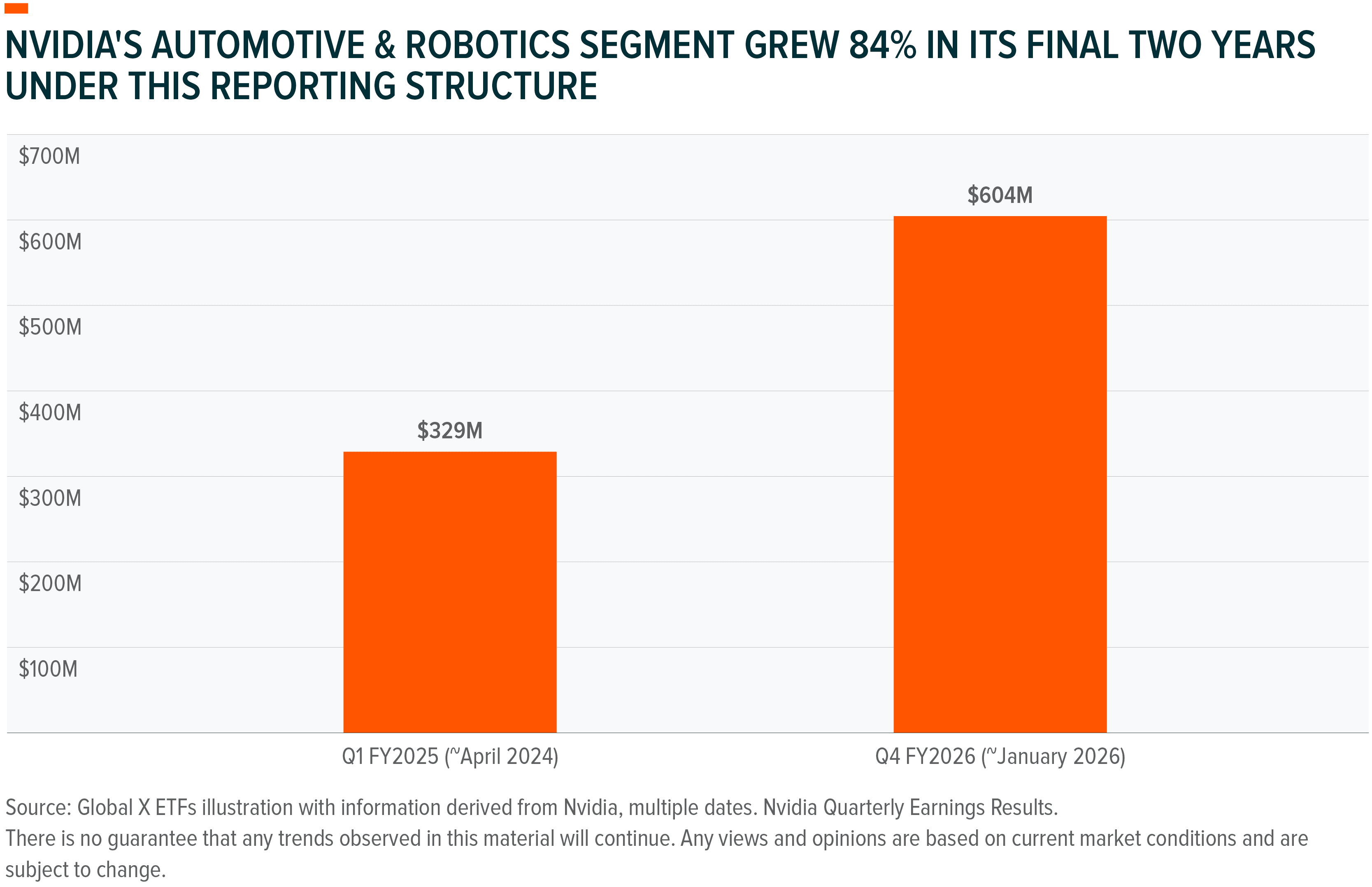
NVIDIA's Automotive and Robotics segment, under its prior reporting structure, grew about 83% over two years before being discontinued.⁴⁹ From Q1 FY2027, NVIDIA folded it into a broader Edge Computing platform, which generated $6.4 billion of quarterly revenue, up 29% year on year, but also includes gaming, PCs and consoles, so that growth cannot be extended past this point.⁵⁰ Investors may need to combine segment data with customer and partner activity to track progress.
The memory layer sits further from the headlines but provides some visibility into the composition of humanoids. On Micron's fiscal Q3 2026 earnings call, CEO Sanjay Mehrotra stated that robotics and autonomous vehicles “portend a robust long-term demand environment for memory and storage,” and estimated that a humanoid robot needs roughly ten times the memory of a highly autonomous vehicle, a gap he expects to widen into a multi-decade upgrade cycle.⁵¹ Micron described modern robots as needing high-bandwidth memory and fast local storage to process what they perceive in real time, putting memory suppliers inside the capital-spending conversation too.⁵²
Foundry capacity tells a related story further upstream. On TSMC's Q2 2026 earnings call, chairman and CEO C.C. Wei described the current build-out as the start of “a new industry” reaching into automotive, humanoids and robotics alongside data centres, expecting demand to stay strong through 2029 or 2030.⁵³
Multiple business models are visible across the ecosystem, echoing what McKinsey has found surveying industrial automation buyers. Platform providers such as NVIDIA sell compute and software broadly, hardware-plus-attach models such as FANUC's layer AI onto equipment already sold, component-supply backlogs don't depend on any single platform winning, and procedure-based recurring revenue such as Intuitive Surgical's extends the relationship past the initial purchase.⁵⁴ A portfolio spread across these archetypes differs structurally from a bet on any single manufacturer.
Physical AI has entered a phase where deployment data can be assessed alongside technological ambition. Industrial robot installations remain above half a million units a year, cobots are gaining share, and AI is already improving the capability of the installed base.⁵⁵
Several of the commitments already discussed extend the visible runway well beyond the current installed base: Schaeffler's actuator backlog runs through 2031, Boston Dynamics' Hyundai-backed plan targets 2028, Japan's national AI-robotics infrastructure targets a 2040 market-share ambition, and TSMC expects demand across automotive, humanoid and robotics applications to stay strong through 2029 or 2030. The Global X Robotics & Artificial Intelligence UCITS ETF (BOTZ LN) is designed to offer exposure to the key drivers of the robotics and AI theme, across a variety of industries and applications.
This document is not intended to be, or does not constitute, investment research as defined by the Financial Conduct Authority.