
Europe

Marketing Communication. Capital at Risk. For Professional Investors Only.
The Global X Team is pleased to release the July 2025 edition of the UCITS Thematic ETF Commentary. This commentary recaps Global X’s classification system for disruptive themes and the thematic ETFs that aim to track them. It also provides industry-level analysis of thematic investing ETFs, looking at new launches and closures, changes in assets under management (AUM), and fund flows.
Click here to download the UCITS Thematic ETF Commentary July 2025
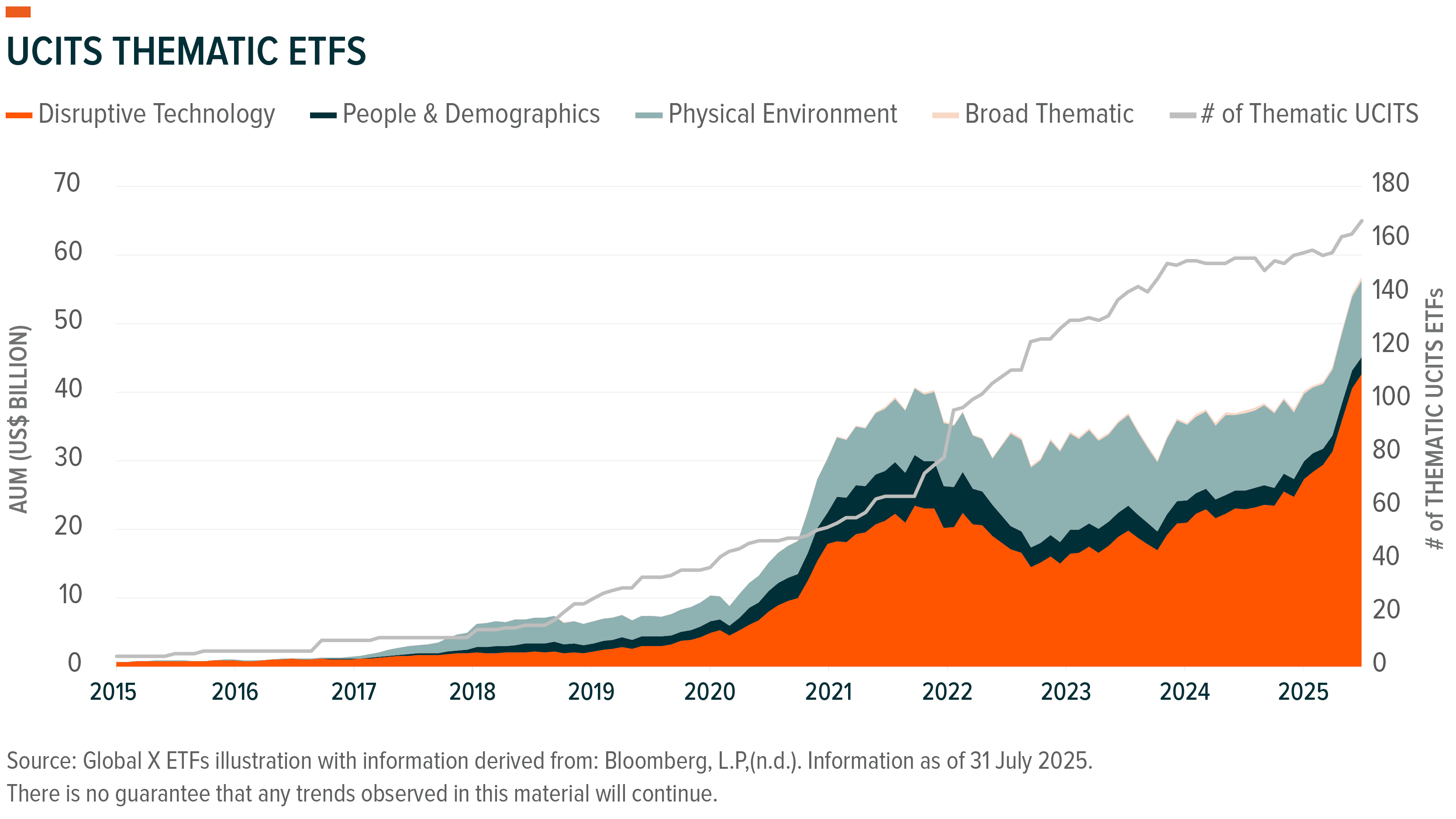
At the end of July 2025, UCITS thematic ETFs represented 2.28% of the UCITS ETF industry’s $2.54 trillion total AUM.2 This is higher than the 2.20% level reached at the end of June 2025.
UCITS Thematic ETF AUM increased to $57.8 billion this month, up 4.5% from June’s AUM of $55.3 billion.3 In comparison, AUM in the broader UCITS ETF industry rose 0.8% month-over-month (MoM).4
AUM for UCITS Thematic ETFs saw an overall increase of $2.46 billion, with net inflows of $1.97 billion. Market performance added $0.49 billion in AUM.5
On a year-over-year basis, UCITS Thematic ETF AUM increased +52.2% from $38.0 billion at the end of July 2025.6
There are currently 170 UCITS thematic ETFs,7 with five new listing in July.
Themes related to Disruptive Technology saw an increase in AUM of +$2.11 billion.8 The Physical Environment category saw an increase in AUM of $395.9 million, while the People & Demographics category saw a decrease in AUM of -$113.1 million.9,10
At the Mega-Theme level, Defence Tech saw the largest net inflows in June, with +$1.19 billion, followed by Big Data with +$465.9 million.11 The Mobility Mega-Theme saw the largest net outflows with -$31.7 million.12
At the thematic level, Machine/Deep Learning (+$536.3 million) exhibited the largest increase in AUM.13
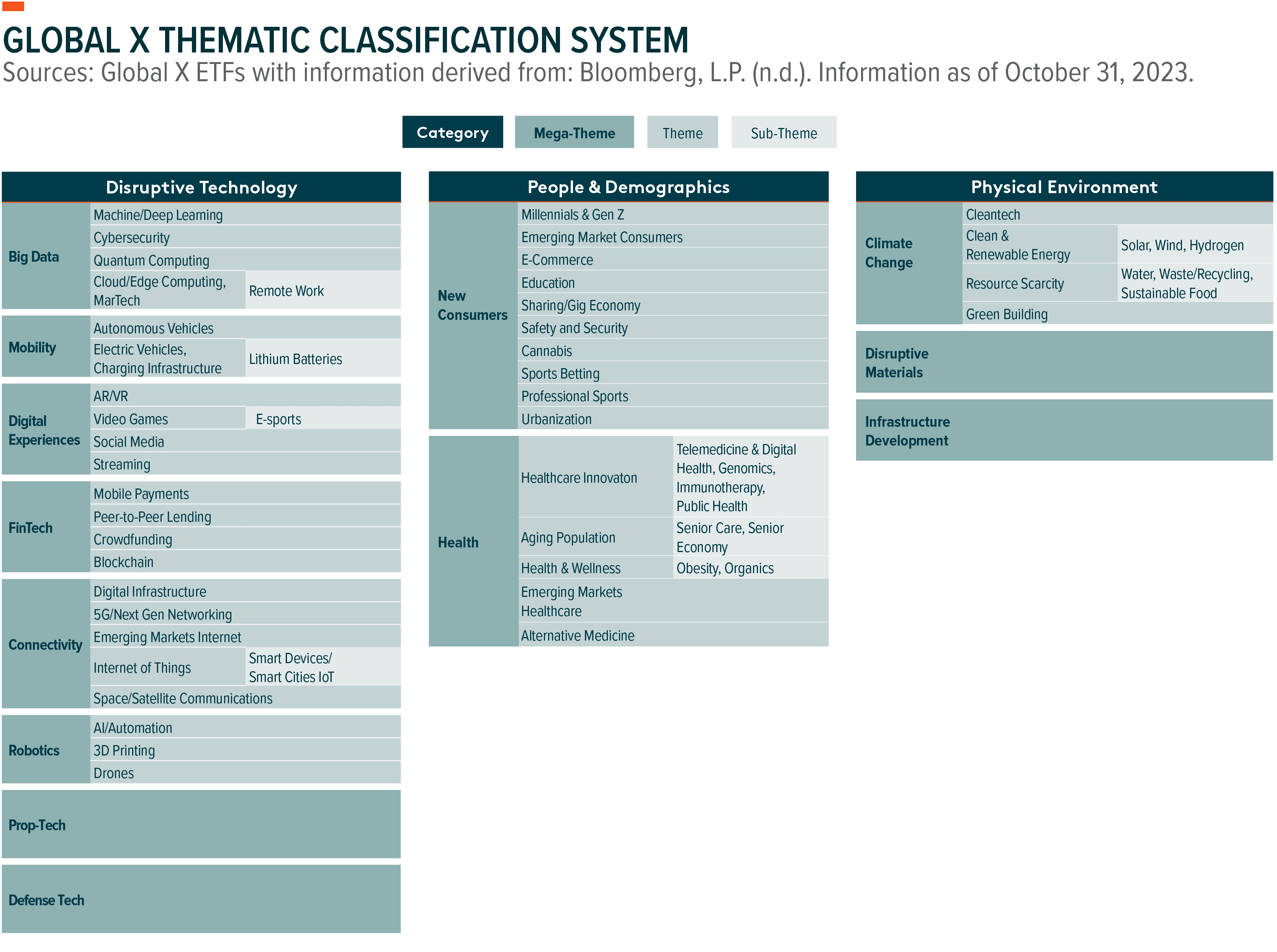
The Global X team has established a thematic classification system that seeks to provide a consistent framework for identifying disruptive themes and categorising the thematic ETF space. Often, conflicting definitions of thematic investing have been seen in the media and financial world, which can lead to confusion about which ETFs are thematic and what themes they are tracking.14 With the introduction of this classification system, it is hoped that more clarity around disruptive themes and their related ETFs may be provided.
Thematic investing can be defined as the process of identifying powerful disruptive macro-level trends and the underlying investments that potentially stand to benefit from the materialisation of those trends.15
By nature, thematic investing is a long term, growth-oriented strategy, that is typically unconstrained geographically or by traditional sector/industry classifications, has low correlation to other growth strategies, and invests in relatable concepts.16
Notably, thematic investing does not consist of ESG, values-based, or policy-driven strategies, unless they otherwise represent a disruptive structural trend (e.g., climate change).17 Furthermore, funds that adhere to traditional sector or industry classifications, or that are used primarily to gain exposure to cyclical trends (e.g., currencies, valuations, inflation) would not appear to be thematic. Finally, alternative asset classes, such as listed infrastructure, MLPs, and ubiquitous commodities would not appear to be thematic.
Global X’s thematic classification system consists of four layers of classifications: 1) Categories; 2) Mega-Themes; 3) Themes; and 4) Sub-Themes, with each layer becoming sequentially narrower in its focus.
‘Categories’ is the broadest layer and represents three potentially fundamental drivers of disruption: exponential advancements in technology (Disruptive Technology), changing consumer habits and demographics (People & Demographics), and the evolving physical landscape (Physical Environment).
One layer down is ‘Mega-Themes’ and these serve as a foundation to multiple potentially transformative forces that appear to be causing substantial changes in a common area. Conceptually, Mega-Themes are a collection of more narrowly targeted Themes. For example, Big Data is a Mega-Theme that consists of themes such as Machine/Deep Learning, Cybersecurity, Quantum Computing, and Cloud/Edge Computing.18
Themes are identified as the specific areas of transformational disruption that appear to be driving technology forward, changing consumer demands, or impacting the environment. There are currently 40 themes in the classification system.
‘Sub-Themes’ are more niche areas, such as specific applications of themes or upstream forces that appear to be driving themes forward. For example, Remote Work is a sub-theme of Cloud/Edge Computing.19
Thematic ETFs aim to target a specific category, mega-theme, theme, or sub-theme. The classification system seeks to find the best potential fit for a specific ETF, analysing its methodology, holdings, and stated objectives. The thematic classification system is reviewed monthly to consider new potential categories, mega-themes, themes, or sub-themes. As a new ETF launches or changes its strategy, its classification is evaluated immediately.
In an uncharted era of new technologies disrupting existing paradigms, demographics reshaping the needs of the world’s population, shifting consumer behaviours forcing changes to existing business models, and dramatic changes in our physical environment, there appears to be a growing need for a consistent framework to track these themes and the investment vehicles providing access to them.
Global X insights do not take into account a person’s own financial position or circumstances of any person or entity in any region or jurisdiction. This information should not be relied upon as a primary basis for any investment decision. Its applicability will depend on the particular circumstances of each investor. There is no guarantee that any trends observed in this material will continue. Any views and opinions are based on current market conditions and are subject to change. This information is not intended to be, or does not constitute, investment research.
This document is not intended to be, or does not constitute, investment research as defined by the Financial Conduct Authority.
1. Bloomberg (n.d.). [Data set]. Data as of 31/07/2025 and accessed on 04/08/2025 from Global X Bloomberg Terminal.
2. Morningstar. [Data set]. Data as of 31/07/2025 and accessed on 04/08/2025 from Global X Morningstar Direct License.
3. Morningstar. [Data set]. Data as of 31/07/2025 and accessed on 04/08/2025 from Global X Morningstar Direct License.
4. Bloomberg (n.d.). [Data set]. Data as of 31/07/2025 and accessed on 04/08/2025 from Global X Bloomberg Terminal.
5. Bloomberg (n.d.). [Data set]. Data as of 31/07/2025 and accessed on 04/08/2025 from Global X Bloomberg Terminal.
6. Global X ETFs based on The Global X Thematic Classification System.
7. Bloomberg (n.d.). [Data set]. Data as of 31/07/2025 and accessed on 04/08/2025 from Global X Bloomberg Terminal.
8. Bloomberg (n.d.). [Data set]. Data as of 31/07/2025 and accessed on 04/08/2025 from Global X Bloomberg Terminal.
9. Bloomberg (n.d.). [Data set]. Data as of 31/07/2025 and accessed on 04/08/2025 from Global X Bloomberg Terminal.
10. Bloomberg (n.d.). [Data set]. Data as of 31/07/2025 and accessed on 04/08/2025 from Global X Bloomberg Terminal.
11. Bloomberg (n.d.). [Data set]. Data as of 31/07/2025 and accessed on 04/08/2025 from Global X Bloomberg Terminal.
12. Bloomberg (n.d.). [Data set]. Data as of 31/07/2025 and accessed on 04/08/2025 from Global X Bloomberg Terminal.
13. Bloomberg (n.d.). [Data set]. Data as of 31/07/2025 and accessed on 04/08/2025 from Global X Bloomberg Terminal.
14. Morningstar. (30 April, 2021). Thematic ETFs:why knowing how to spot one is half the battle.
15. Morningstar (18 May, 2023). What is Thematic Investing?
16. Morningstar. (30 April, 2021). Thematic ETFs:why knowing how to spot one is half the battle.
17. Morningstar (18 May, 2023). What is Thematic Investing?
18. Global X Thematic Classification System
19. Ibid.