
Europe

The Global X Team is pleased to release the August 2026 edition of the UCITS Thematic ETF Commentary. This commentary recaps Global X’s classification system for disruptive themes and the thematic ETFs that aim to track them. It also provides industry-level insights of thematic investing ETFs, looking at new launches and closures, changes in assets under management (AUM), and fund flows.
Click here to download the UCITS Thematic ETF Commentary August 2026
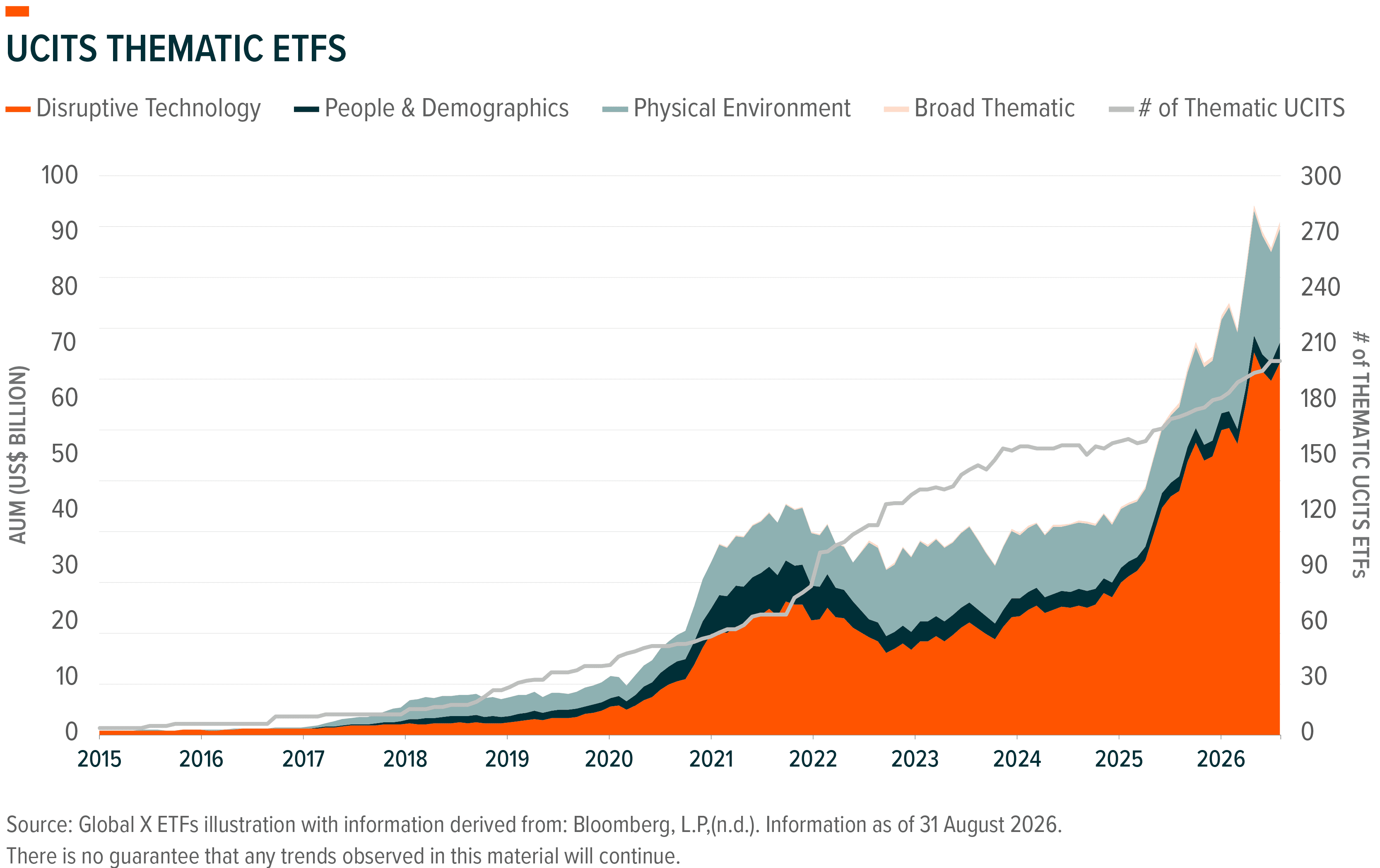
Following July’s moderation, August saw a broad rebound in UCITS thematic ETFs combined with stronger equity markets and with renewed investor demand for technology infrastructure.² At the end of August 2026, UCITS thematic ETFs represented 2.49% of the UCITS ETF industry’s $3.68 trillion total AUM.³ This is an increase from the 2.46% level at the end of July 2026.⁴
UCITS Thematic ETF AUM increased to $91.67 billion this month, up 5.30% from July’s AUM of $87.05 billion.⁵ In comparison, AUM in the broader UCITS ETF industry grew 3.89% month-over-month (MoM).⁶
AUM for UCITS Thematic ETFs saw an overall increase of $4.62 billion, with net inflows of $1.26 billion.⁷ Market performance resulted in a $3.35 billion increase in AUM.⁸
On a year-over-year basis, UCITS Thematic ETF AUM increased +54.0% from $59.54 billion at the end of August 2025.⁹
There are currently 201 UCITS thematic ETFs, with no listings and no delistings in August.¹⁰
The Disruptive Technology category saw an increase in AUM of $3.2 billion.¹¹ This was followed by the Physical Environment category, which saw a $948.8 million increase in AUM.¹² The Disruptive Technology category saw net inflows of $777.6 million followed by Physical Environment which saw inflows of $335.6 million.¹³
At the Mega-Theme level, Big Data saw the largest inflows in August, with +$371.0 million, followed by Infrastructure Development with +$252.5 million, FinTech +$171.0 million, Climate Change with +$146.7 million, Robotics with +$114.5 million, Health with +$92.1 million and Defence Tech with +$68.4 million.¹⁴
Big Data’s leadership was driven by Machine/Deep Learning, which gathered $217.5 million in flows.¹⁵ Cybersecurity also attracted approximately $91.5 million, consistent with strong operating results from security providers and the growing need to secure enterprise AI adoption.¹⁶,¹⁷ Robotics inflows of $114.5 million aligned with ongoing investment in physical AI, including new platforms and tools for humanoid robots, autonomous vehicles and industrial applications announced during the month.¹⁸
FinTech inflows were concentrated in Blockchain, which gathered $173.8 million.¹⁹ Regulatory developments and a rebound in digital-asset markets may have supported sentiment. On 18 August, the U.S. Securities and Exchange Commission proposed “Regulation Crypto Assets,” intended to create a tailored securities-offering framework and clearer pathways for certain crypto-asset issuers.²⁰
Physical Environment flows were led by Electrification (+$198.1 million) and Resource Scarcity (+$133.0 million).²¹ On 27 August, the European Investment Bank approved €9.2 billion in new financing, including support for electricity grids, renewable energy and district-heating infrastructure in Europe, as well as grid and clean-energy projects in partner countries.²² This provided a tangible policy and capital-spending catalyst for infrastructure and climate-related exposures. Resource Scarcity sentiment was also supported by constrained copper supply; the CME Group reported that limited new mine supply, flooding-related production risks and potential U.S. tariff changes were keeping attention focused on medium-term supply tightness.²³
At the thematic level, Machine/Deep Learning (+$1.08 billion) exhibited the largest increase in AUM, followed by Cybersecurity (+$654.2 million), AI/Automation (+$504.6 million) and Resource Scarcity (+$353.2 million).²⁴ Conversely, 5G & Internet of Things (-$25.6 million) and Millennials and Gen Z (-$4.0 million) recorded the largest theme outflows during August.²⁵ The pattern might suggest that investors remained selective, favouring themes with visible earnings momentum, policy support or near-term capital investment while reducing exposure to areas where catalysts appeared less immediate.
In an uncharted era of new technologies disrupting existing paradigms, demographics reshaping the needs of the world’s population, shifting consumer behaviours forcing changes to existing business models, and dramatic changes in our physical environment, there appears to be a growing need for a consistent framework to track these themes and the investment vehicles providing access to them.
Global X insights do not take into account a person’s own financial position or circumstances of any person or entity in any region or jurisdiction. This information should not be relied upon as a primary basis for any investment decision. Its applicability will depend on the particular circumstances of each investor. There is no guarantee that any trends observed in this material will continue. Any views and opinions are based on current market conditions and are subject to change. This information is not intended to be, or does not constitute, investment research.
This document is not intended to be, or does not constitute, investment research as defined by the Financial Conduct Authority.
1. Bloomberg (n.d.). [Data set]. Data as of 31/08/2026 and accessed on 07/09/2026 from Global X Bloomberg Terminal.
2. Ibid.
3. Ibid.
4. Ibid.
5. Ibid.
6. ETFBook [Data set]. Data as of 31/08/2026 and accessed on 07/09/2026 filtered for UCITS products.
7. Bloomberg (n.d.). [Data set]. Data as of 31/08/2026 and accessed on 07/09/2026 from Global X Bloomberg Terminal.
8. Ibid.
9. Ibid.
10. Morningstar. [Data set]. Data as of 31/07/2026 and accessed on 04/08/2026 from Global X Morningstar Direct License.
11. Bloomberg (n.d.). [Data set]. Data as of 31/08/2026 and accessed on 07/09/2026 from Global X Bloomberg Terminal.
12. Ibid.
13. Ibid.
14. Ibid.
15. Ibid.
16. Ibid.
17. CrowdStrike, CrowdStrike Reports Second Quarter Fiscal Year 2027 Financial Results, 26 August 2026.
18. NVIDIA, NVIDIA Announces Financial Results for Second Quarter Fiscal 2027, 26 August 2026.
19. Bloomberg (n.d.). [Data set]. Data as of 31/08/2026 and accessed on 07/09/2026 from Global X Bloomberg Terminal.
20. U.S. Securities and Exchange Commission, SEC Proposes New Regulation Crypto Assets, 18 August 2026.
21. Bloomberg (n.d.). [Data set]. Data as of 31/08/2026 and accessed on 07/09/2026 from Global X Bloomberg Terminal.
22. European Investment Bank, EIB approves over €9 billion in financing to boost European businesses and energy autonomy, 27 August 2026.
23. CME Group, Copper futures slip amid supply disruptions and tariff uncertainty, 27 August 2026.
24. Bloomberg (n.d.). [Data set]. Data as of 31/08/2026 and accessed on 07/09/2026 from Global X Bloomberg Terminal.
25. Ibid.
26. Morningstar. Interested in Thematic Funds? Here’s what you need to know. 24 September 2024.
27. Morningstar (18 May, 2023). What is Thematic Investing?
28. Ibid.
29. Global X Thematic Classification System
30. Ibid.
31. Ibid.
Global X’s Thematic Classification System
The Global X team has established a thematic classification system that seeks to provide a consistent framework for identifying disruptive themes and categorising the thematic ETF space. Often, conflicting definitions of thematic investing have been seen in the media and financial world, which can lead to confusion about which ETFs are thematic and what themes they are tracking.²⁶ With the introduction of this classification system, it is hoped that more clarity around disruptive themes and their related ETFs may be provided.
Defining Thematic Investing
Thematic investing can be defined as the process of identifying powerful disruptive macro-level trends and the underlying investments that potentially stand to benefit from the materialisation of those trends.²⁷
By nature, thematic investing is a long term, growth-oriented strategy, that is typically unconstrained geographically or by traditional sector/industry classifications, can have low correlation to other growth strategies, and invests in relatable concepts.²⁸
Notably, thematic investing does not consist of ESG, values-based, or policy-driven strategies, unless they otherwise represent a disruptive structural trend (e.g., climate change).²⁹ Furthermore, funds that adhere to traditional sector or industry classifications, or that are used primarily to gain exposure to cyclical trends (e.g., currencies, valuations, inflation) would not appear to be thematic. Finally, alternative asset classes, such as listed infrastructure, MLPs, and ubiquitous commodities would not appear to be thematic.
Classifying Themes
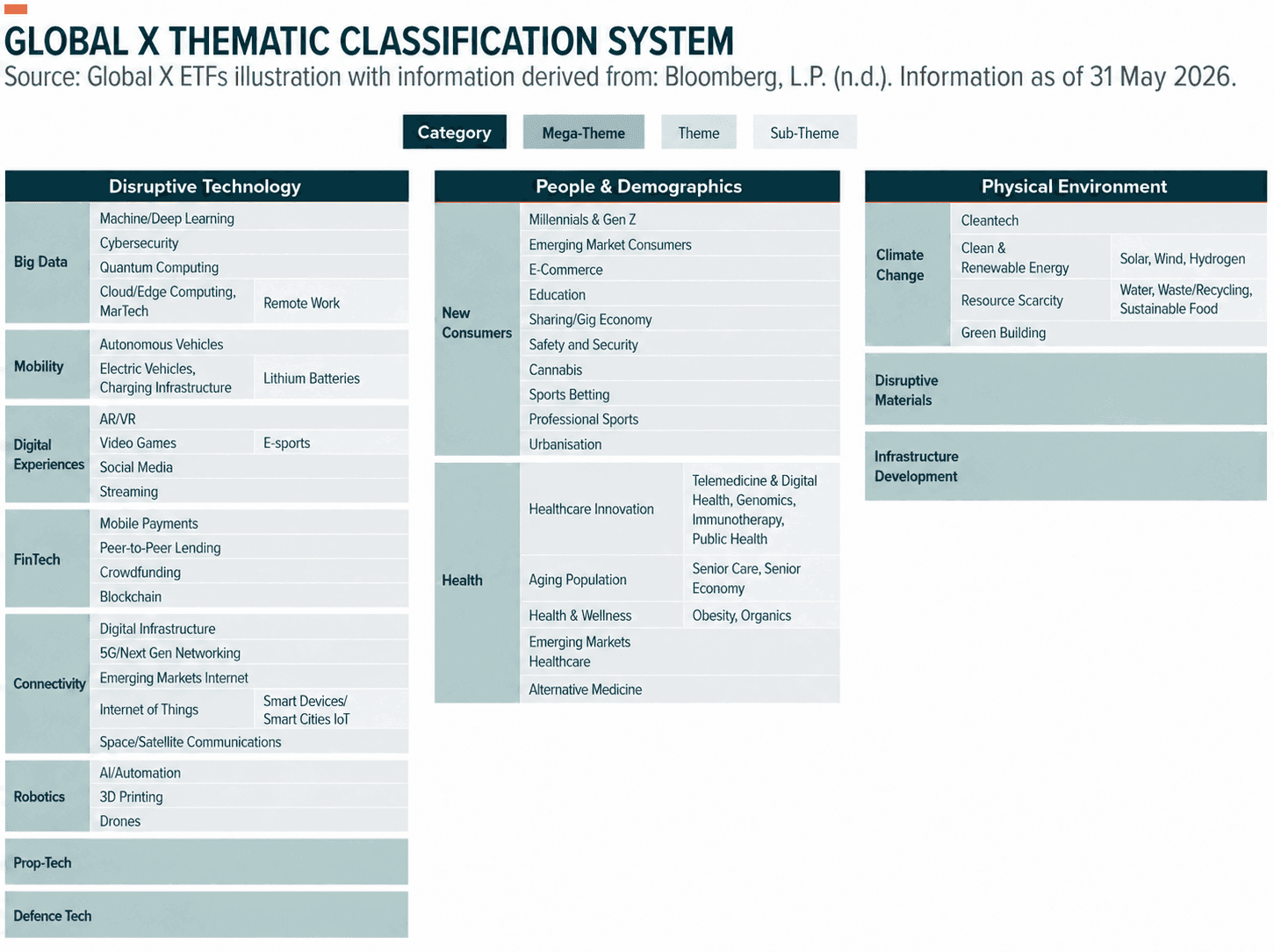
Global X’s thematic classification system consists of four layers of classifications: 1) Categories; 2) Mega-Themes; 3) Themes; and 4) Sub-Themes, with each layer becoming sequentially narrower in its focus.
‘Categories’ is the broadest layer and represents three potentially fundamental drivers of disruption: exponential advancements in technology (Disruptive Technology), changing consumer habits and demographics (People & Demographics), and the evolving physical landscape (Physical Environment).
One layer down is ‘Mega-Themes’ and these serve as a foundation to multiple potentially transformative forces that appear to be causing substantial changes in a common area. Conceptually, Mega-Themes are a collection of more narrowly targeted Themes. For example, Big Data is a Mega-Theme that consists of themes such as Machine/Deep Learning, Cybersecurity, Quantum Computing, and Cloud/Edge Computing.³⁰
Themes are identified as the specific areas of transformational disruption that appear to be driving technology forward, changing consumer demands, or impacting the environment. There are currently 40 themes in the classification system.
‘Sub-Themes’ are more niche areas, such as specific applications of themes or upstream forces that appear to be driving themes forward. For example, Remote Work is a sub-theme of Cloud/Edge Computing.
Thematic ETFs aim to target a specific category, mega-theme, theme, or sub-theme. The classification system seeks to find the best potential fit for a specific ETF, assessing its methodology, holdings, and stated objectives. The thematic classification system is reviewed monthly to consider new potential categories, mega-themes, themes, or sub-themes. As a new ETF launches or changes its strategy, its classification is evaluated immediately.