
Europe

The Global X Team is pleased to release the October 2026 edition of the UCITS Thematic ETF Commentary. This commentary recaps Global X’s classification system for disruptive themes and the thematic ETFs that aim to track them. It also provides industry-level insights of thematic investing ETFs, looking at new launches and closures, changes in assets under management (AUM), and fund flows.
Click here to download the UCITS Thematic ETF Commentary October 2026
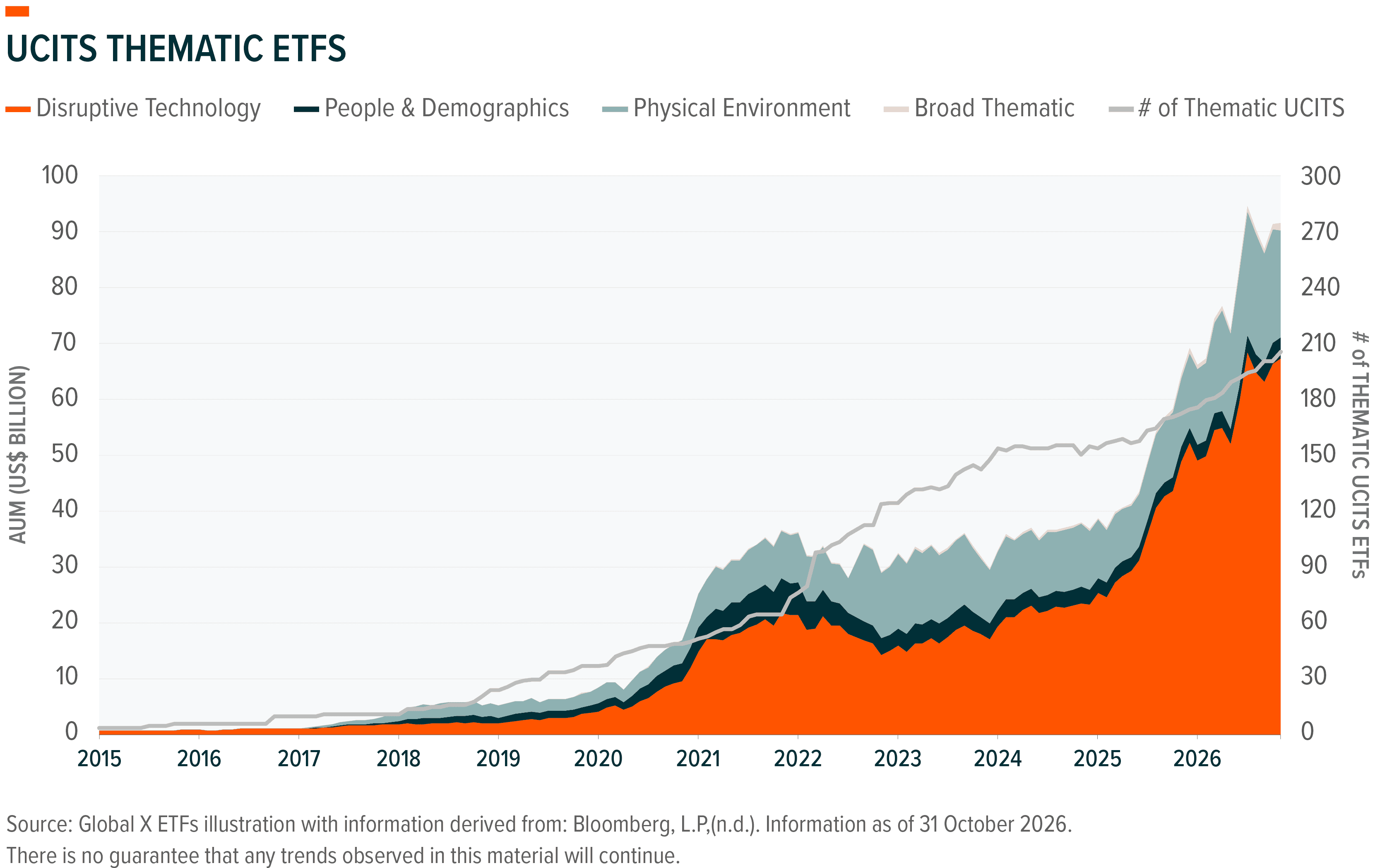
October saw a decline in UCITS thematic ETF assets, with market movements more than offsetting net inflows during the month.² At the end of October 2026, UCITS thematic ETFs represented 2.43% of the UCITS ETF industry’s $3.63 trillion total AUM, a slight increase from the 2.52% level at the end of September 2026.³
UCITS Thematic ETF AUM decreased to $88.3 billion this month, down 3.8% from September’s AUM of $91.7 billion.⁴ In comparison, AUM in the broader UCITS ETF industry fell 0.39% month-over-month (MoM).⁵
AUM for UCITS Thematic ETFs saw an overall decrease of $3.44 billion, with net inflows of $8.29 million.⁶ Market performance resulted in a $4.27 billion decrease in AUM.⁷
On a year-over-year basis, UCITS Thematic ETF AUM increased +27.3% from $69.3 billion at the end of October 2025.⁸
There are currently 210 UCITS thematic ETFs, with 3 listings and no delistings in October.⁹
The Disruptive Technology category recorded the largest decrease in AUM, falling $2.09 billion, followed by Physical Environment, which declined $1.46 billion.¹⁰ However, Disruptive Technology continued to attract the strongest net inflows, gathering $946.7 million, followed by Broad Thematic with $124.3 million.¹¹ Physical Environment recorded net outflows of $322.1 million.¹²
At the Mega-Theme level, Big Data saw the largest inflows in October, with +$868.5 million, followed by Health with +$103.5 million, Robotics with $100.7 million and Connectivity with $70.8 million.¹³ Conversely, Climate Change recorded outflows of $241.8 million, whilst Defence Tech saw withdrawals of $186.5 million.¹⁴
Big Data’s leadership was underpinned by Cybersecurity, which gathered $483.1 million, and Machine/Deep Learning, which attracted $422.0 million.¹⁵ Cybersecurity remained a prominent theme during October, following a joint warning issued by European cybersecurity authorities calling for immediate action to address two critical vulnerabilities in PHP, a widely used technology underpinning websites and applications.¹⁶ The vulnerabilities were subsequently added to the U.S. Cybersecurity and Infrastructure Security Agency’s Known Exploited Vulnerabilities catalogue.¹⁷ These developments reinforced the relevance of vulnerability management and cyber resilience, providing a supportive backdrop for interest in the theme.
Machine/Deep Learning inflows continued despite a $1.14 billion decline in the theme’s AUM, highlighting the distinction between investor allocations and changes in asset values.¹⁸ October’s technology earnings illustrated the tension between strong demand for AI infrastructure and concerns over its cost. Continued investment supported the longer-term demand narrative, although financing costs and the timing of returns remained important considerations for investors.
Robotics attracted $100.7 million through the AI/Automation theme.¹⁹ During October, NVIDIA expanded its Isaac robotics platform at GTC Berlin, announcing new development tools and a humanoid reference platform with Agile Robots.²⁰ The announcements provided a further example of efforts to move physical AI from research into practical deployment, offering relevant industry context for continued allocations to robotics.
People & Demographics inflows were concentrated in Health, which gathered $103.5 million.²¹ Within Health, Healthcare Innovation attracted $124.3 million, partly offset by withdrawals elsewhere in the mega-theme.²² These allocations suggest continued investor interest in medical innovation, even as the wider thematic landscape experienced a decline in assets. October’s healthcare dealmaking also highlighted pharmaceutical companies’ continued interest in externally developed innovation and specialised treatments, providing a constructive backdrop for the theme. ²³
Physical Environment flows were weakest in Climate Change, with Clean & Renewable Energy recording net outflows of $252.4 million.²⁴ Infrastructure Development and Disruptive Materials also experienced withdrawals, of $36.3 million and $44.1 million respectively.²⁵
At the thematic level, Cybersecurity recorded the largest increase in AUM, rising $554.2 million, followed by Healthcare Innovation with $192.5 million.²⁶ Conversely, Machine/Deep Learning fell $1.14 billion and Clean & Renewable Energy declined $822.4 million, recording the largest absolute decreases in AUM during October.²⁷
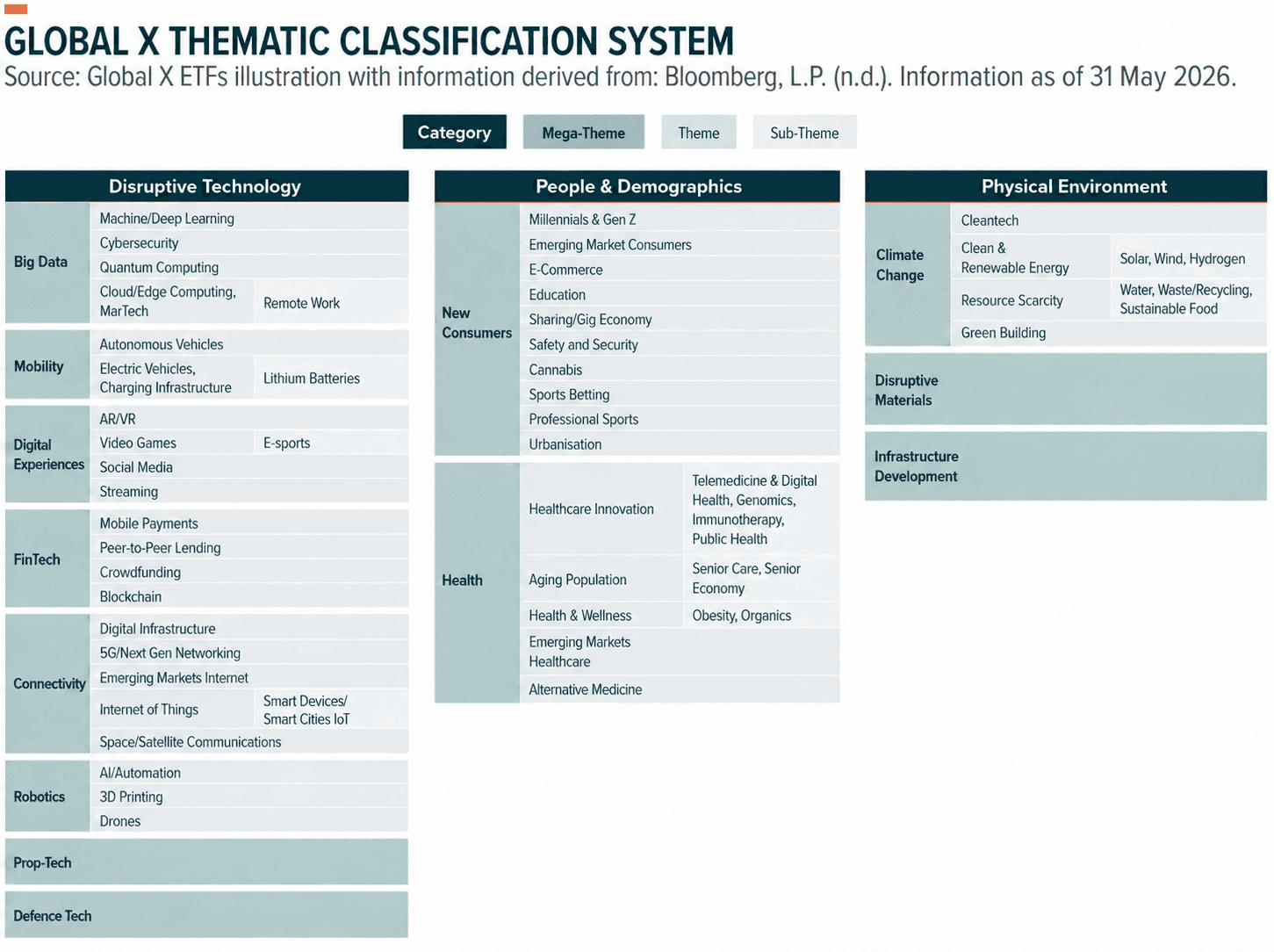
In an uncharted era of new technologies disrupting existing paradigms, demographics reshaping the needs of the world’s population, shifting consumer behaviours forcing changes to existing business models, and dramatic changes in our physical environment, there appears to be a growing need for a consistent framework to track these themes and the investment vehicles providing access to them.
Global X insights do not take into account a person’s own financial position or circumstances of any person or entity in any region or jurisdiction. This information should not be relied upon as a primary basis for any investment decision. Its applicability will depend on the particular circumstances of each investor. There is no guarantee that any trends observed in this material will continue. Any views and opinions are based on current market conditions and are subject to change. This information is not intended to be, or does not constitute, investment research.
This document is not intended to be, or does not constitute, investment research as defined by the Financial Conduct Authority.
1. Bloomberg (n.d.). [Data set]. Data as of 31/10/2026 and accessed on 03/11/2026 from Global X Bloomberg Terminal.

2. Ibid.

3. Ibid.

4. Ibid.

5. ETFBook [Data set]. Data as of 31/10/2026 and accessed on 03/11/2026 filtered for UCITS products.

6. Bloomberg (n.d.). [Data set]. Data as of 31/10/2026 and accessed on 03/11/2026 from Global X Bloomberg Terminal.

7. Ibid.

8. Ibid.

9. Morningstar. [Data set]. Data as of 31/10/2026 and accessed on 03/11/2026 from Global X Morningstar Direct License.

10. Bloomberg (n.d.). [Data set]. Data as of 31/10/2026 and accessed on 03/11/2026 from Global X Bloomberg Terminal.

11. Ibid.

12. Ibid.

13. Ibid.

14. Ibid.

15. Ibid.

16. ENISA, Joint statement on critical PHP vulnerabilities, 21 October 2026.

17. Canadian Centre for Cyber Security, PHP security advisory (AV26-1070) – Update 1, 21 October 2026, updated 27 October 2026.

18. Bloomberg (n.d.). [Data set]. Data as of 31/10/2026 and accessed on 03/11/2026 from Global X Bloomberg Terminal.

19. Ibid.

20. NVIDIA, NVIDIA Advances Isaac Platform for General-Purpose Robotics With New Reference Humanoid, Frameworks, Simulation Pipelines and Data, 21 October 2026.

21. Bloomberg (n.d.). [Data set]. Data as of 31/10/2026 and accessed on 03/11/2026 from Global X Bloomberg Terminal.

22. Ibid.

23. Silence Therapeutics, Silence Therapeutics Enters into Agreement to be Acquired by Merck KGaA, Darmstadt, Germany, 19 October 2026.

24. Boomberg (n.d.). [Data set]. Data as of 31/10/2026 and accessed on 03/11/2026 from Global X Bloomberg Terminal.

25. Ibid.

26. Bloomberg (n.d.). [Data set]. Data as of 31/10/2026 and accessed on 03/11/2026 from Global X Bloomberg Terminal.

27. Ibid.

28. Morningstar. Interested in Thematic Funds? Here’s what you need to know. 24 September 2024.

29. Morningstar (18 May, 2023). What is Thematic Investing?

30. Ibid.

31. Global X Thematic Classification System

32. Ibid.

33. Ibid.

Global X’s Thematic Classification System
The Global X team has established a thematic classification system that seeks to provide a consistent framework for identifying disruptive themes and categorising the thematic ETF space. Often, conflicting definitions of thematic investing have been seen in the media and financial world, which can lead to confusion about which ETFs are thematic and what themes they are tracking.²⁸ With the introduction of this classification system, it is hoped that more clarity around disruptive themes and their related ETFs may be provided.

Defining Thematic Investing

Thematic investing can be defined as the process of identifying powerful disruptive macro-level trends and the underlying investments that potentially stand to benefit from the materialisation of those trends.²⁹
By nature, thematic investing is a long term, growth-oriented strategy, that is typically unconstrained geographically or by traditional sector/industry classifications, can have low correlation to other growth strategies, and invests in relatable concepts.³⁰
Notably, thematic investing does not consist of ESG, values-based, or policy-driven strategies, unless they otherwise represent a disruptive structural trend (e.g., climate change).³¹ Furthermore, funds that adhere to traditional sector or industry classifications, or that are used primarily to gain exposure to cyclical trends (e.g., currencies, valuations, inflation) would not appear to be thematic. Finally, alternative asset classes, such as listed infrastructure, MLPs, and ubiquitous commodities would not appear to be thematic.

Classifying Themes

Global X’s thematic classification system consists of four layers of classifications: 1) Categories; 2) Mega-Themes; 3) Themes; and 4) Sub-Themes, with each layer becoming sequentially narrower in its focus.
‘Categories’ is the broadest layer and represents three potentially fundamental drivers of disruption: exponential advancements in technology (Disruptive Technology), changing consumer habits and demographics (People & Demographics), and the evolving physical landscape (Physical Environment).
One layer down is ‘Mega-Themes’ and these serve as a foundation to multiple potentially transformative forces that appear to be causing substantial changes in a common area. Conceptually, Mega-Themes are a collection of more narrowly targeted Themes. For example, Big Data is a Mega-Theme that consists of themes such as Machine/Deep Learning, Cybersecurity, Quantum Computing, and Cloud/Edge Computing.³²
Themes are identified as the specific areas of transformational disruption that appear to be driving technology forward, changing consumer demands, or impacting the environment. There are currently 40 themes in the classification system.
‘Sub-Themes’ are more niche areas, such as specific applications of themes or upstream forces that appear to be driving themes forward. For example, Remote Work is a sub-theme of Cloud/Edge Computing.³³
Thematic ETFs aim to target a specific category, mega-theme, theme, or sub-theme. The classification system seeks to find the best potential fit for a specific ETF, assessing its methodology, holdings, and stated objectives. The thematic classification system is reviewed monthly to consider new potential categories, mega-themes, themes, or sub-themes. As a new ETF launches or changes its strategy, its classification is evaluated immediately.