
Europe

Marketing Communication. Capital at risk. For Professional Investors Only. Please read fund legal documentation before making any final investment decisions.
Technology no longer sits in one sector, and is increasingly embedded across industries not classed as Information Technology.¹ As a consequence, companies such as Amazon, Alphabet, Meta and Uber are now synonymous with ‘technology’, however none of them are formally classified as such, making the challenge of gaining passive broad-based Tech exposure increasingly difficult to attain.²
Existing sector-based approaches may appear to offer precision, however are dictated by classifications that now fall short in reflecting the cutting edge of tech innovation. Other approaches, such as that taken by the Nasdaq-100 provide substantial growth and technology exposure, however its exclusions-based universe is constrained by primary exchange listing rather than an inclusionary approach based on business activity.³ For example, it cannot hold NYSE-listed TSMC, Oracle, Salesforce, Visa or SAP, yet ~15% of it sits in Staples, Health Care, Utilities, Materials, Energy and Industrials.⁴
The NYSE® 100 Index (NYSX) starts from the business activity, and is designed to address the above gaps by targeting selected technology and tech-enabled sub-industries across five US listing venues and includes ADRs, thus offering a global exposure.⁵
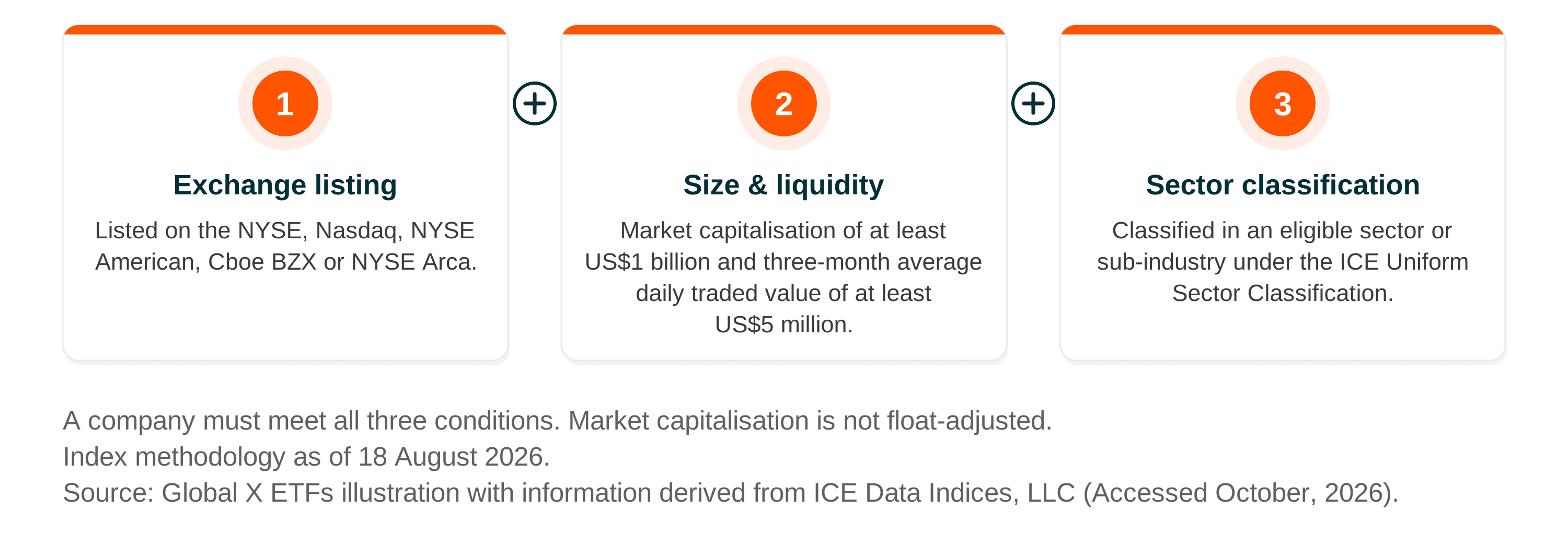
The NYSE 100 Index screens by business activity first. Listing venue is a secondary test.⁶ A company qualifies if it meets three conditions:
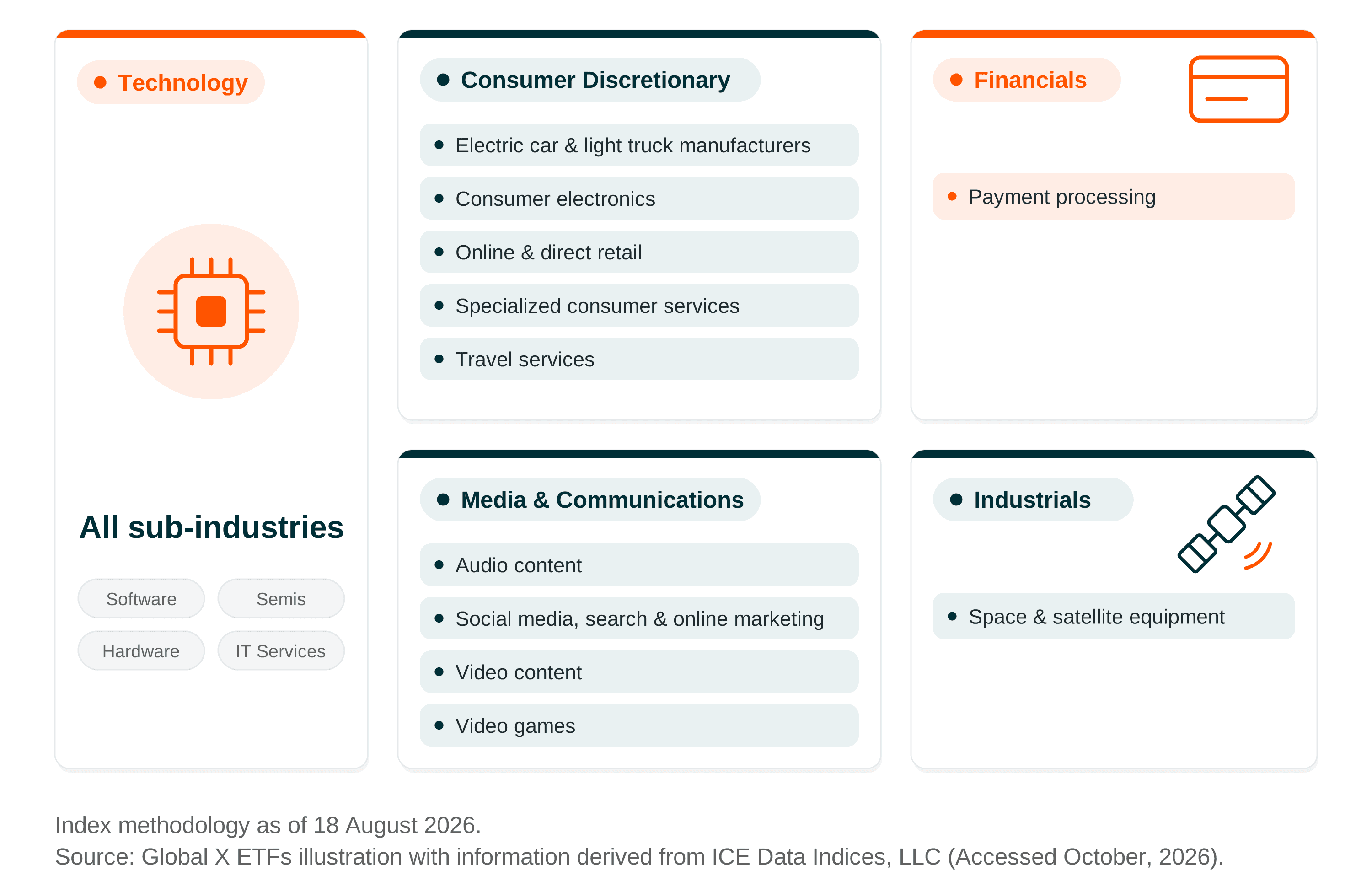
All Information Technology sub-industries are eligible. Outside IT, the methodology targets specific activities.
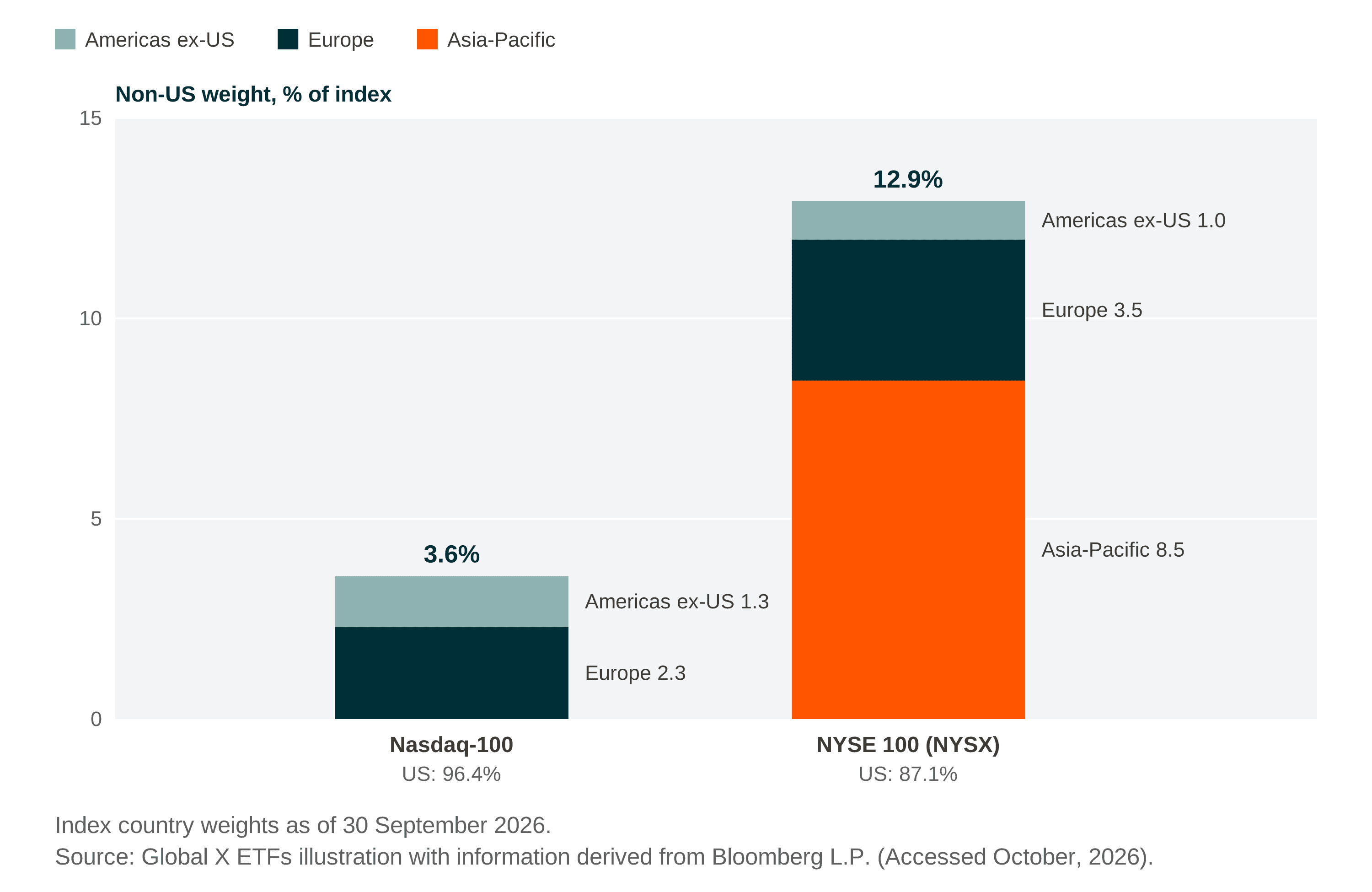
International issuers can enter through their US listings. Current holdings include TSMC (Taiwan), SK hynix (South Korea), ASML (Netherlands), Alibaba (China) and SAP (Germany).⁷
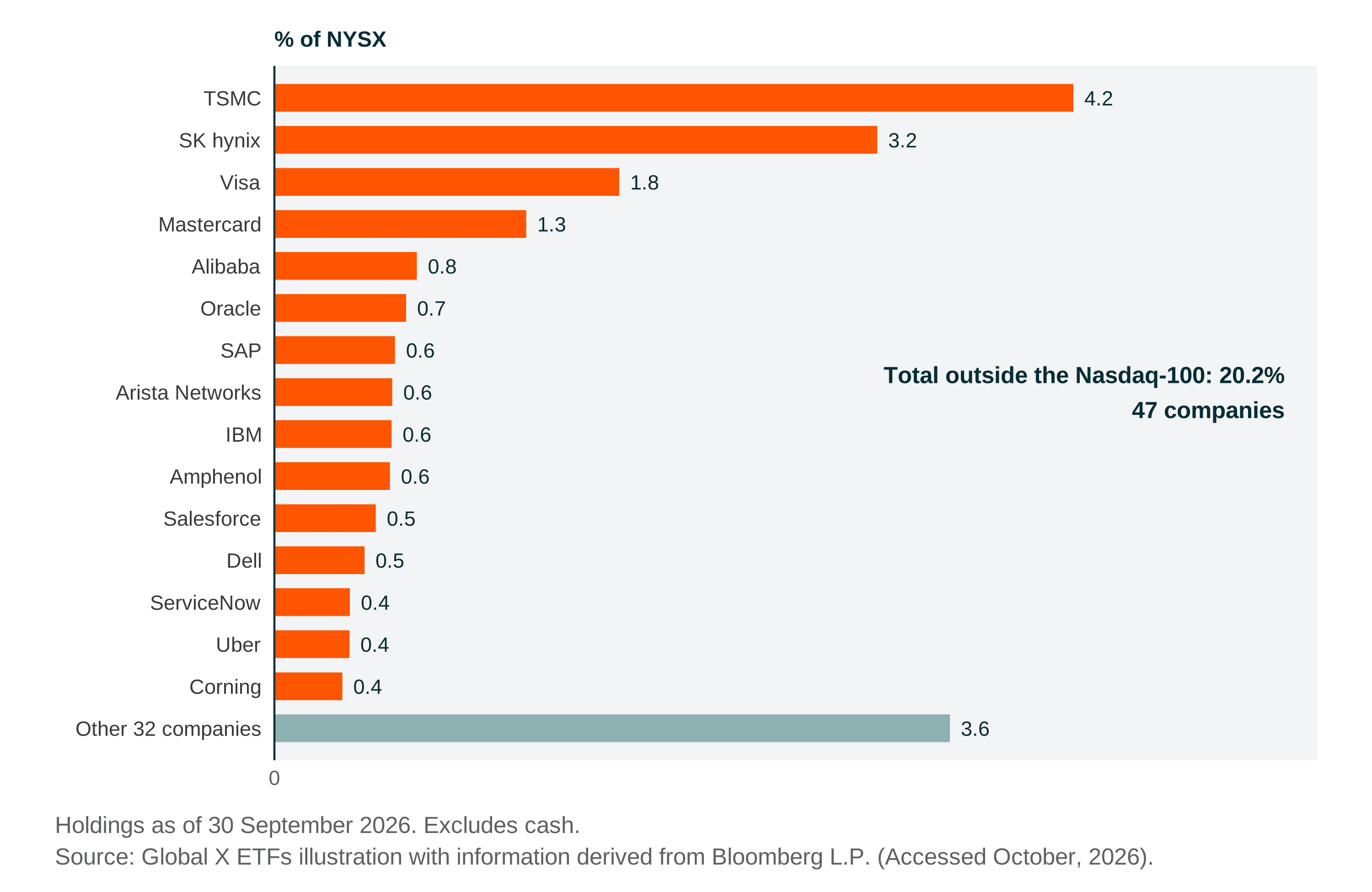
SK hynix shows how the two approaches diverge even on the same exchange. Its ADRs began trading on Nasdaq in July 2026, and it is a 2.9% NYSE® 100 position (as of 30th September 2026).⁸ It is not a Nasdaq-100 constituent.⁹
NYSE 100 Weights of Companies Not Included in the Nasdaq-100 Index (Weights as of 30 September 2026)
NYSX is not an all-country index.¹⁰ Its international reach depends on which companies hold eligible US listings. That still covers the leading non-US names in semiconductors and enterprise software, at present.¹¹
The index’s eligible sub-sectors can evolve over time, subject to the index provider’s methodology governance process, allowing NYSX to adapt as the technology and tech-enabled growth landscape changes.¹²
Info Tech accounts for roughly 40% of the S&P 500.¹³ Eight technology-associated companies classified elsewhere (Amazon, Alphabet, Meta, Tesla, Visa, Mastercard, Netflix and Uber) account for a further 16% (as of 30th September 2026). ¹⁴ Information Technology sector funds hold none of them.¹⁵ ¹⁶
Twice in eight years, GICS has moved some of the largest technology-associated companies out of Information Technology. In September 2018, Alphabet and Meta (then Facebook) moved into the newly created Communication Services sector.¹⁷ In March 2023, Visa, Mastercard and PayPal moved to a new Financials sub-industry, Transaction & Payment Processing Services.¹⁸
Other platforms have never been classified as technology. Amazon sits in Consumer Discretionary (Broadline Retail), Tesla in Consumer Discretionary (Automobile Manufacturers) and Uber in Industrials (Passenger Ground Transportation).¹⁹
The NYSE® 100 ranks eligible companies using four factors²⁰:
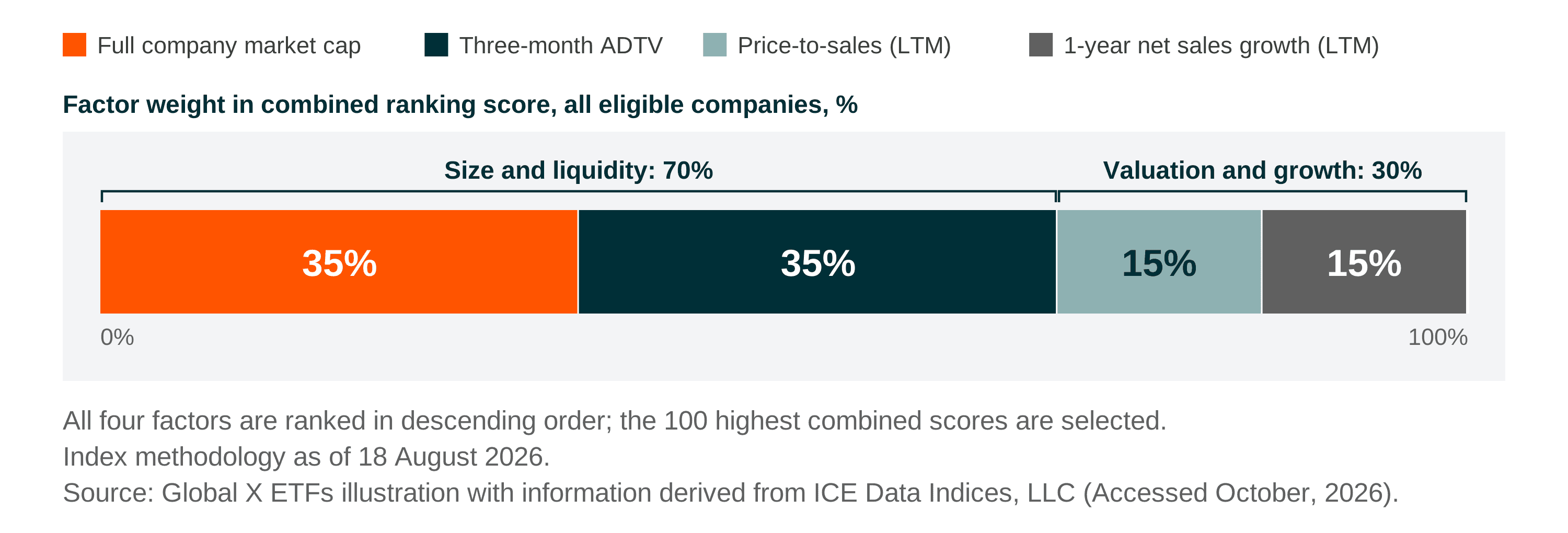
Eligible electric vehicle manufacturers use a modified score in which price-to-sales carries a 40% weight.²¹ Companies are ranked on the combined score, and the top 100 eligible names are selected, subject to index rules.²²
These factors determine which companies enter the index but do not set each company’s portfolio weight. After selection, constituents are weighted by float-adjusted market capitalisation, subject to concentration limits.²³
Technology’s expansion into a cross-sector ecosystem has become a defining feature of today’s market leadership.²⁴ Many of the largest and most influential U.S. companies now operate as interconnected platforms spanning hardware, software, media, payments, mobility, and artificial intelligence.²⁵ Their scale, profitability, and reinvestment capacity have positioned them at the centre of equity market performance in recent years.
At the same time, the drivers of next-generation technology growth are broadening. Artificial intelligence infrastructure, cloud computing, digital advertising, e-commerce logistics, electronic payments, and connected mobility are increasingly interdependent.²⁶ Leadership in one area often reinforces leadership in another, creating a circular ecosystem dynamic rather than isolated sector growth.²⁷
For investors, this environment presents a portfolio construction challenge. Traditional sector definitions may underrepresent key participants in this ecosystem, while investing in products that track broad market indexes may dilute exposure with companies less directly tied to technology-enabled growth.²⁸ As technology continues to function as a foundational layer of the U.S. economy, a more intentional approach to capturing that ecosystem may be increasingly relevant.
This document is not intended to be, or does not constitute, investment research as defined by the Financial Conduct Authority.
¹ Bloomberg L.P. (Data Accessed October 2026)
² Bloomberg L.P. (Data Accessed October 2026)
³ Nasdaq Global Indexes (2026) Nasdaq-100 Index (NDX) Index Methodology
⁴ Ibid
⁵ Global X and ICE Data Indices (18 Aug 2026) Global X NYSE® 100 UCITS ETF (NYSX) Index Methodology
⁶ Ibid
⁷ Ibid
⁸ Bloomberg L.P. (Data Accessed October 2026)
⁹ Ibid
¹⁰ Ibid
¹¹ Ibid
¹² Ibid
¹³ Bloomberg L.P. (Data Accessed October 2026)
¹⁴ Ibid
¹⁵ State Street Global Advisors (9 Oct 2026) SPDR S&P 500 ETF Trust: Sector Weights
¹⁶ S&P Dow Jones Indices and MSCI (31 Mar 2022) S&P Dow Jones Indices and MSCI Announce Revisions to the Global Industry Classification Standard (GICS) Structure in 2023
¹⁷ S&P Dow Jones Indices and MSCI (15 Nov 2017) S&P Dow Jones Indices and MSCI Announce Revisions to the Global Industry Classification Standard (GICS) Structure in 2018
¹⁸ S&P Dow Jones Indices and MSCI (11 Jan 2018) S&P Dow Jones Indices and MSCI Announce Select List of Companies Changing Due to Revisions to the GICS Structure in 2018
¹⁹ Ibid
²⁰ Ibid
²¹ Ibid
²² Ibid
²³ Ibid
²⁴ FactSet (21 May 2026) “Mag 7” and Other 493 S&P 500 Companies Are Reporting Highest Earnings Growth Since 2021
²⁵ Alphabet (Feb 2026) Form 10-K 2025
²⁶ Federal Reserve Bank of St. Louis (12 Jan 2026) Tracking AI’s Contribution to GDP Growth
²⁷ Bloomberg (24 Sep 2025) Nvidia-OpenAI Deal Sparks Concerns Over Circular Financing in AI Boom
²⁸ Ibid