

Marketing Communication. Capital at Risk. Professional Investors Only. Please read fund legal documentation before making any final investment decisions.
Just a few years ago, data centres were designed to store files and run everyday software. Today, they are being reimagined from the ground up to function as AI super-factories, running advanced AI workloads round the clock.1 This transformation is not subtle, but rather a structural shift in how these giant computing hubs are designed, where they are built, and what power sources power them.2
One of the key drivers of this shift is the rapid commercialisation of AI we’ve seen over the past few years. Platforms like ChatGPT have grown in a short period of time to attract 800 million weekly users, rivalling top internet platforms in scale.3 New AI products are seemingly launching every day, while query volume is scaling at an unprecedented pace.4 Across customer service, medical diagnostics, logistics, and fraud detection, AI applications are surging into production, seemingly limited only by the availability of AI-tuned computing infrastructure.5
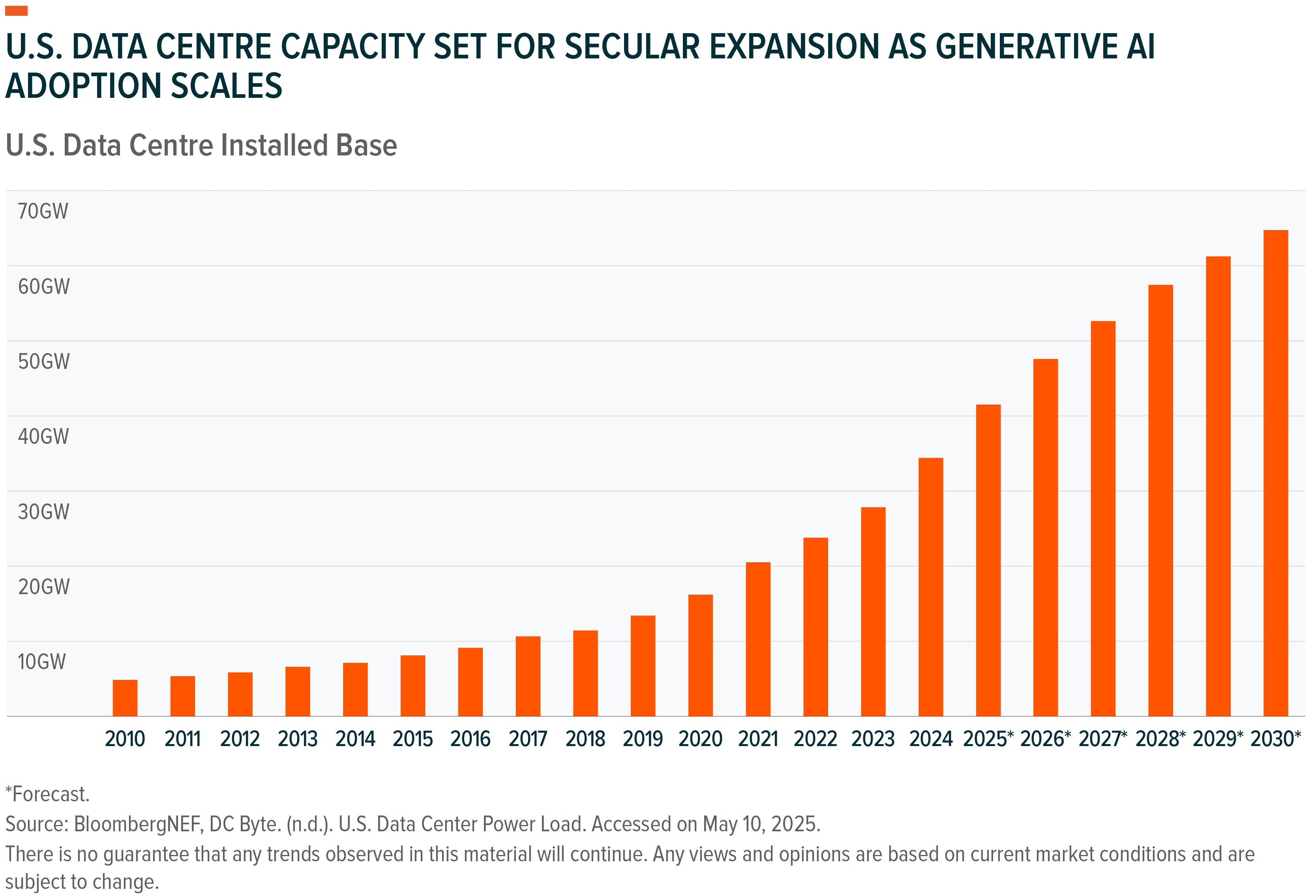
To support this growth in AI computing needs and to enable frontier tech like Physical AI or Quantum Computing, global data centre capacity needs to expand significantly.6
Key Takeaways
- Data centres are adapting from simply storing files and running software to hubs that produce and operate AI.
- Data centre supply remains tight, pricing power is rising, and new investments - backed by multi-year leases - are growing.7
- VPN aims to provide targeted exposure to the digital infrastructure ecosystem, which could be a defensive way to gain exposure to the multi-decade AI paradigm shift.8
Data Centres the New AI Toll Roads?
Over the past decade, data centres were primarily built to handle the surge in data creation and software adoption. Between 2015 and 2025, global data assets surged by 1,258%.9 Global software spending may nearly quadruple.10 Consumers - empowered by 5G, better mobile devices, and the mass digitisation of daily life during the pandemic - were the primary drivers of this buildout. Mobile games, streaming, chat apps, payment apps, and such compounded the trend.11
That dynamic arguably shifted with the arrival of ChatGPT. Conversational AI became the mass market interface almost seemingly overnight, spiking user engagement and pushing large language models to process more data, faster.12 At the same time, users' expectations grew, with queries accompanied by images, videos, and longer context windows, further compounding computing demands and triggering a wave of new AI applications.13 All of this appears to have resulted in unprecedented processing capacity demand that the AI industry hadn’t fully anticipated.14
The industry has responded by investing aggressively and urgently.15 Globally $455 billion was spent on data centres in 2024, up 51% year-over-year YoY.16 And yet, the true scale of power-hungry, latency-sensitive AI compute is potentially beginning to reveal itself as applications remain tightly metered and the availability of AI servers, especially with sufficient power connectivity, continues to be a critical bottleneck.17
From a user-demand perspective, have we just scratched the surface of the opportunity? Only 34% of U.S. adults claim to be users of ChatGPT.18 Beyond that, most users will probably experience conversational AI weightlessly without logging into apps like ChatGPT, as AI it gets integrated into social media platforms, digital maps, productivity software, and smartphones. New paradigms like Agentic AI or Physical AI remain majorly constrained by the availability of computing infrastructure today.19
Scarcity Drives Pricing Power in AI-Era Data Centres
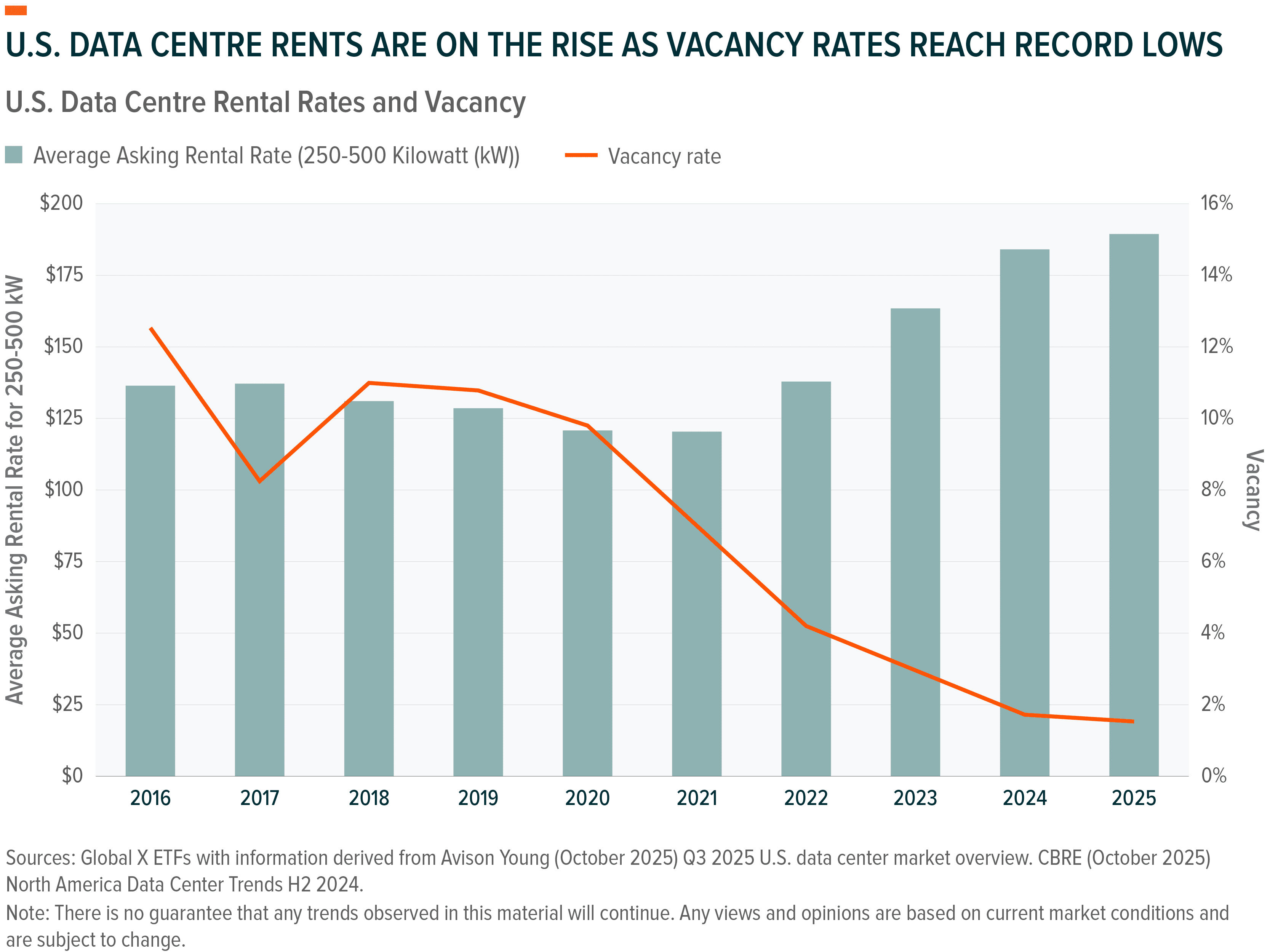
As demand for AI compute grows, U.S. data centre capacity appears to be reaching critical limits.20 Across most major U.S. data centre markets, vacancy rates are at historic lows.21 In Q1 2025, vacancy stood at just 1.6%, with key hubs like Northern Virginia operating even tighter.22 This trend persists even amid record breaking new construction activity in 2024, which saw nearly 7 GW of new capacity brought to market, twice that of the year prior.23 For context, new data centre absorption grew 34% YoY in 2024, after a 26% growth in 2023.24 Given the typical 12-18-month data centre development timeline, this imbalance is forecast by some to continue well into 2026.25
The scarcity of capacity could potentially create a powerful tailwind for incumbent operators. With few alternatives available at the scale and size that AI adopters require, customers might be less inclined to switch suppliers, keeping churn low and occupancy high. That could give data centre operators the upper hand when negotiating contract renewals, often locking in higher rents with minimal pushback.26 Rental rates had already surged to all-time highs by the end of 2024.27 Rising yields, which can indicate stronger pricing relative to development costs, may further enhance the advantage of scale, which larger operators can translate into better financing terms.28
Moreover, leading data centre operators typically structure multi-year leases with hyperscalers and large enterprises, often spanning 10 to 15 years.29 These agreements seem to support predictable earnings, particularly as clients become deeply embedded within specific facility ecosystems. This stickiness arguably reinforces the defensive growth profile of data centres.30
Data Centre Operators Race to Bring AI Projects to Market
As customer pipelines for AI capacity grows, some major colocation data centre operators are racing to scale and bring new capacity online.
- Equinix: Equinix is a leading U.S. based co-location data centre provider. During its Q2 2025 earnings, Equinix highlighted an aggressive expansion to grow its global data centre footprint.31 The company is currently advancing 56 projects, across 24 countries, including 12 x-Scale projects, which are Equinix’s Hyperscale data centre facilities.32
- Digital Realty: Another major U.S. data centre wholesaler - serving clients such as IBM, Oracle, and Meta Platforms - is actively scaling to meet rising demand.33 The company is currently developing approximately 499 MW of new capacity across the Americas, with major projects concentrated in Northern Virginia, Chicago, and Dallas.34
AI Is No Longer Just a U.S. Story, It Is Going Global
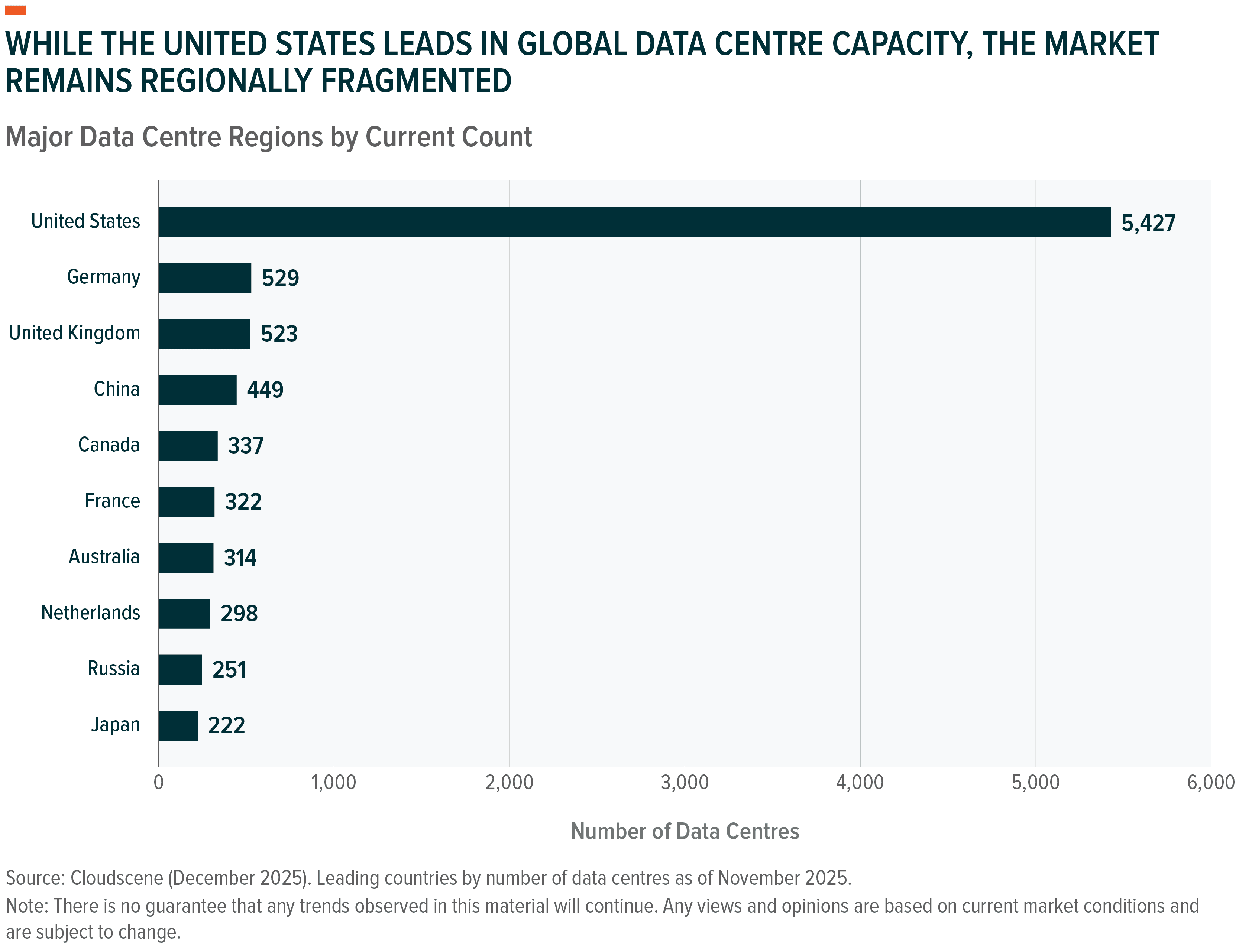
While the U.S. continues to lead in AI innovation35 - thanks in part to its dominance in semiconductors through companies like Nvidia - the data centre infrastructure story appears to be rapidly globalising.36
In China, open-source models like DeepSeek appear to have unlocked rapid deployment of AI at scale.37 Should enterprise and consumer use cases expand, infrastructure demands may grow in parallel. Power consumption from Chinese data centres alone may triple by 2030 to nearly 600 TWh, nearly twice that of the entire country of Indonesia.38
Regions like Europe also appear to be accelerating their AI infrastructure buildouts.39 Some estimates suggest that the EU is to absorb a record 937 MW of capacity in 2025, up 43% YoY, driven by sovereign AI efforts and regional digitisation strategies.40 Similar trends can be noted across other key regions, racing to bring new AI-data centre capacity online.41 Both Equinix and Digital Realty, two of the largest independent data centre operators worldwide, have scored many of their new deals in international markets this year.42,43
Worldwide, data centre power demand may grow to 945 TWh by the end of this decade, more than doubling from the total consumption at the end of 2024.44 The majority of this expansion is yet to be built. For investors, this potential and global dispersion could reinforce the opportunity for exposure beyond just U.S. hyperscalers.
VPN: Targeting the Long Tail of Digital Infrastructure Buildout
The Global X Data Center REITs & Digital Infrastructure UCITS ETF (VPN) is designed to provide targeted exposure to the companies powering the backbone of AI and next-generation computing. The fund seeks to track the Solactive Data Center REITs & Digital Infrastructure v2 Index, which emphasises depth, global reach, and thematic purity:
-
- Targeted Value Chain: VPN aims to capture companies across the full data centre and digital infrastructure stack, including developers and operators of data centres, developers and operators of cellular towers, and companies that manufacture the servers and hardware used in these facilities.
- Global Exposure: VPN inherently takes a global approach to capturing companies, aiming to offer exposure to key data centre markets like China, South Korea, as these regions are increasingly key to the tech industry and AI’s advancement.
- Modified Market Cap Weighting:With a modified market-cap weighted methodology, VPN allows leading players to grow in influence in the ETF. The fund’s index caps Data Centre or Cellular Tower holdings at 12%, with an even stricter 2% cap applied to Server and/or Hardware companies.
Additionally, the index ensures high thematic purity by requiring constituents to generate at least 50% of their revenue from the Data Centre or Cellular Tower-related sub-themes, which maintains a sharp focus on computing businesses.
Conclusion: Data Centre & Digital Infrastructure the Next AI Frontier?
Data Centres are becoming the checkpoint where every AI interaction must pass through., Data Centres are the utilities of the AI age. Computing needs could also expand aggressively from everyday conversational AI apps towards Physical AI and high-performance computing, such as those of Quantum Computing. Data centre operators who can bring capacity online quickly, and monetise it through their existing clientele and distribution, could potentially stand to benefit.