

Marketing Communication. Capital at risk. For Professional Investors Only. Please read fund legal documentation before making any final investment decisions.
Download the report to explore the developments shaping four major investment themes.
Artificial Intelligence, Data Centres and Digital Infrastructure
Open-Weight vs Closed Weight Models
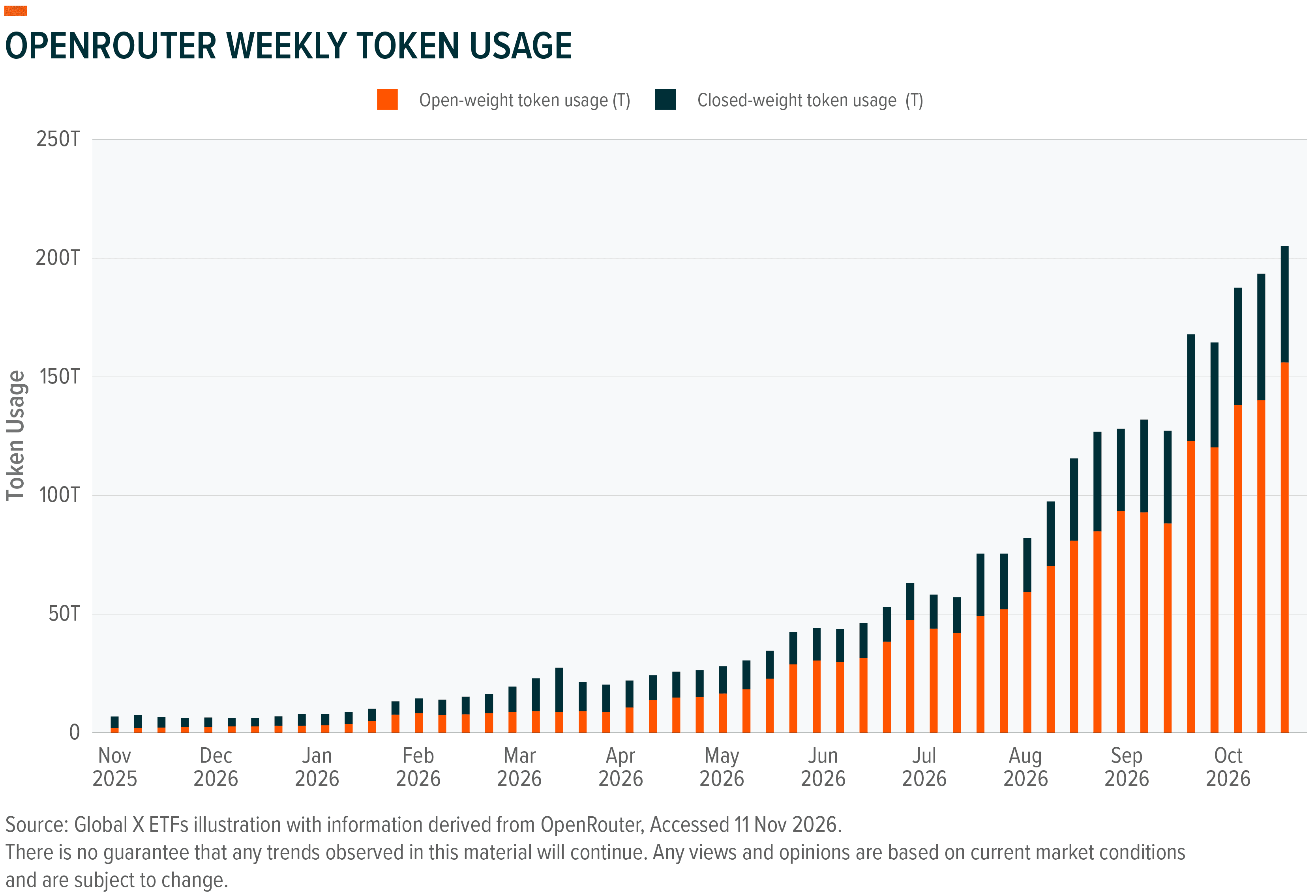
With the “tokenmaxxing” trend seen earlier in 2026 giving way to a more value-conscious AI approach,¹ token allocation offers an insight into this shift. Token usage measured by OpenRouter, which routes user requests across different AI models (see chart below), highlights significant growth in open-weight usage, which overtook closed-weight usage in February and has remained ahead since.²
There are three key takeaways:
- Token usage does not equate directly to revenue. Indeed, cost is one of the main reasons users switch from closed-weight to open-weight models. While open-weight models handled 72% of token traffic on OpenRouter in September, they captured only 27% of AI spending.³
- The narrowing capability gap between open-and closed-weight models has supported open-weight adoption. The performance gap narrowed from 15% in May 2023 to 3.3% in March 2026, having briefly fallen to 0.5% in August 2024,⁴ with open-weight models trailing frontier models by four months as of May 2026.⁵
- Enterprise adoption of open-weight models appears to be at an early stage. A Capgemini survey of large enterprises showed a growing willingness among executives to use cheaper open-weight models, with nearly six in ten planning to increase adoption.⁶
Data centres, particularly colocation facilities, can serve a range of models, so continued AI adoption could support broader demand for compute capacity. Another sign of the persistent mismatch between data centre supply and -demand comes from Anthropic's S-1, in which it reported $5 billion in short-term compute costs during Q3, as user demand exceeded planned capacity.
Artificial Intelligence and Semiconductors
AI Coding, Chip Software, and the CUDA Moat
Advances in AI capabilities this year have been closely linked to coding. The release of Claude Code in February was the primary driver behind the ‘SaaSpocalypse’ that sent software stocks lower.⁷ Improved coding capabilities have fuelled the growth of AI-generated code and AI agents. In its 2025 Annual Report, Alphabet noted that nearly 75% of all new code at Google was AI-generated and approved by engineers, up from 50% in autumn 2025,⁸ while Microsoft noted that more than a third of all pull requests on GitHub are now opened by AI agents.⁹ AI models are also being used to develop future models.¹⁰ Claude led 26% of model R&D tasks at Anthropic in August, up from 1% in March.¹¹
Launched in 2006, Nvidia’s CUDA software platform has been a significant part of its moat through a reinforcing cycle of performance and adoption. Strong initial development and support improved the performance of Nvidia chips, driving adoption, and attracting more developers to use the platform.¹² Companies long sought to reduce CUDA’s market share, and in turn Nvidia’s dominance in the chip market. Efforts have ranged from open standards such as OpenCL launched in 2009,¹³ to direct competitors like AMD’s ROCm launched in 2016,¹⁴ and hyperscalers, which have developed their own chips.¹⁵,¹⁶,¹⁷ Just last month, Google and Amazon each launched their own versions of PyTorch (an open source platform developed by Facebook in 2016), TorchTPU and TorchNeuron respectively.¹⁸
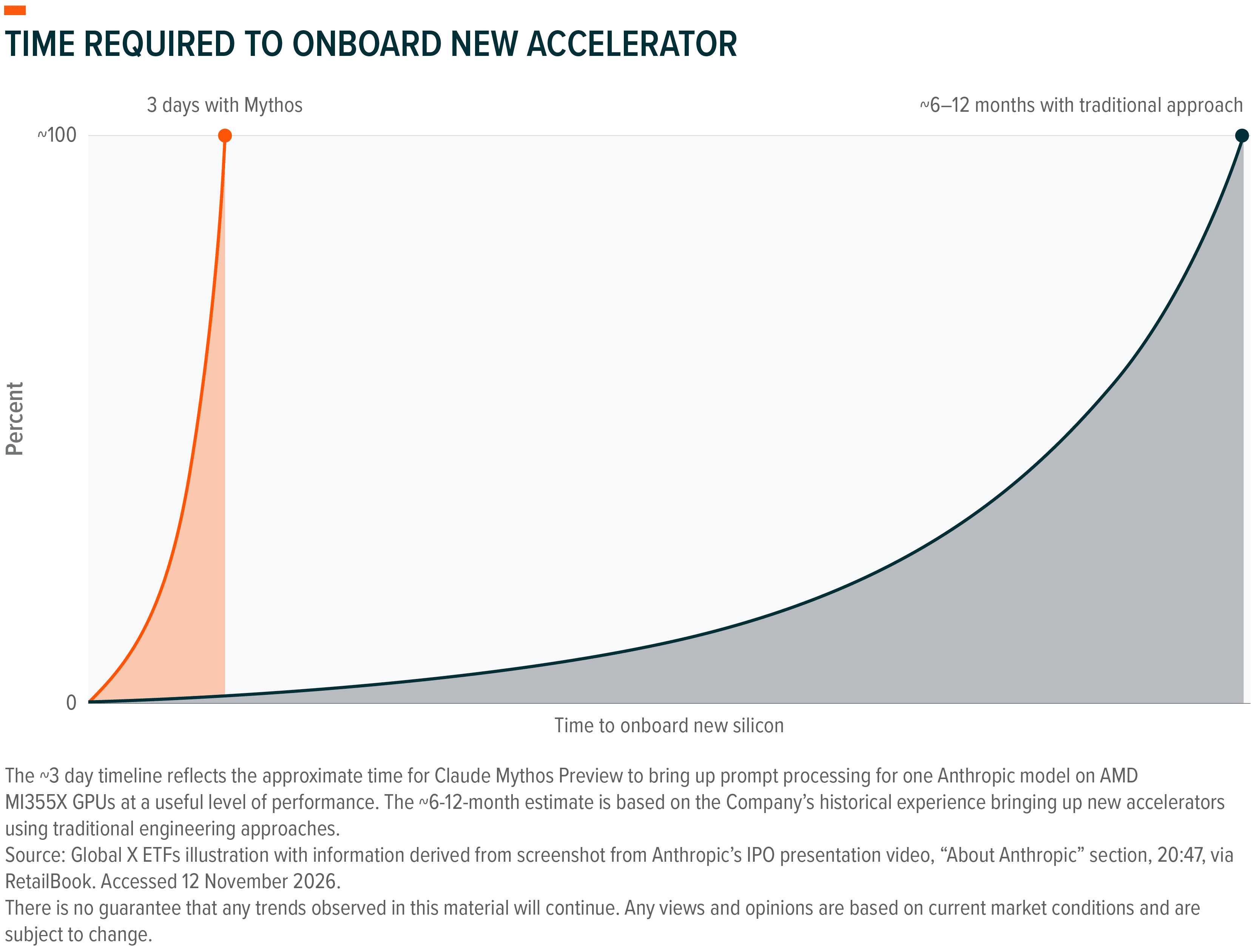
These AI coding capabilities have now extended to chip software. In its IPO materials, Anthropic announced that it had used its Mythos model to cut the time needed to run Claude on a new GPU from a typical 6-12 month to three days.¹⁹ If scalable, this approach could make it easier for developers to switch from CUDA to other platforms, and consequently, to other chip providers. In its S-1, Anthropic describes its approach to compute as a “single, fungible pool from multiple strategic partners”, allowing it to use the most productive capacity available at any given time.²⁰ This could broaden the GPU market, especially if other AI model labs can adopt a similar approach.
Artificial Intelligence
Anthropic IPO
Anthropic released its Form S-1 towards the end of October, providing valuable insights into the economics of a frontier AI lab.²¹
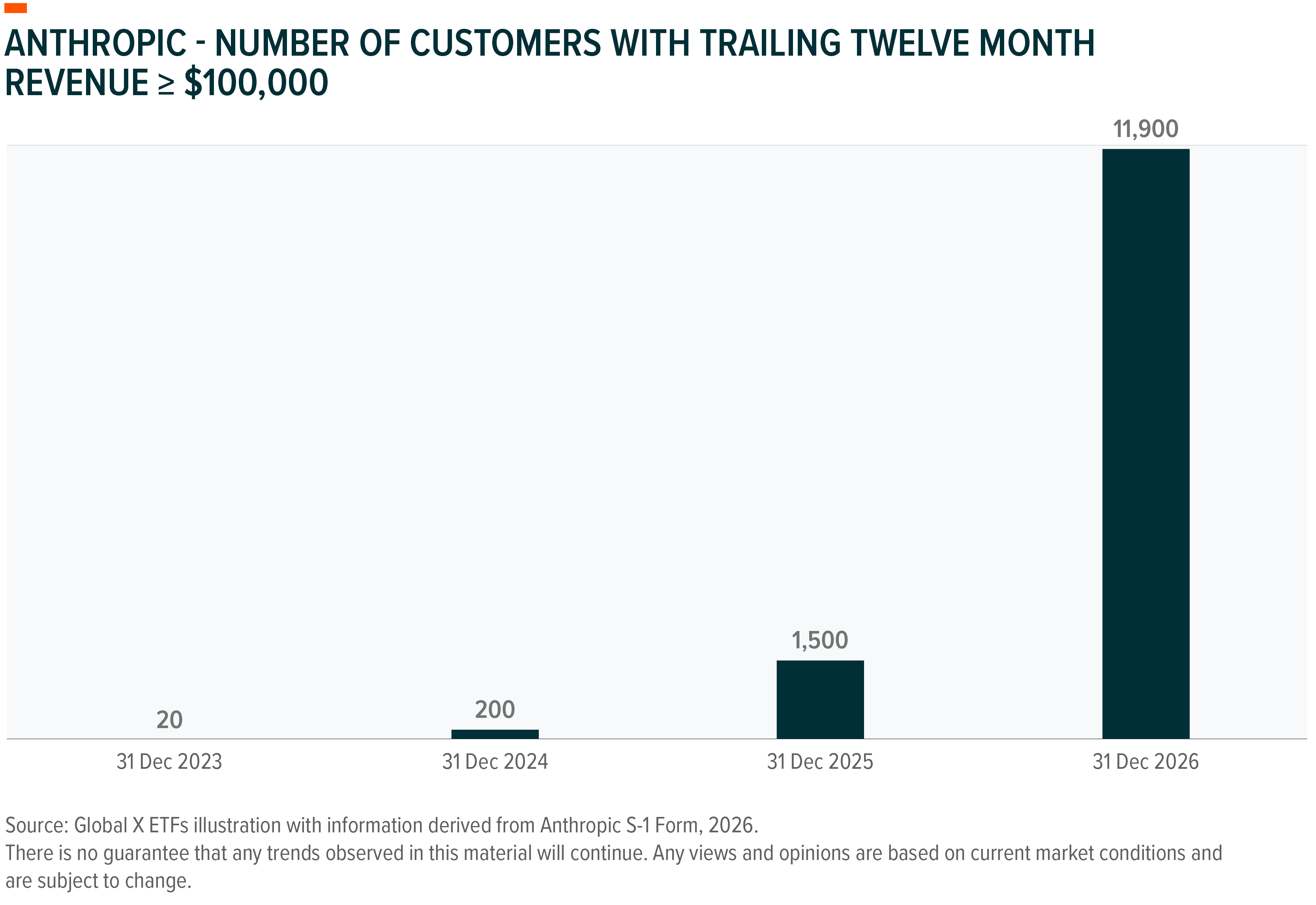
The first notable takeaway was the trajectory of enterprise spending, with the number of users spending more than $100,000 over the trailing twelve months rising from ~1,500 at the end of last year, to more than 11,900 as of 30 September 2026.²²
Secondly, the company highlighted a 900% Net Retention Rate (NRR), which measures spending by existing customers as a percentage of their spending in the previous year.²³ While Anthropic is not directly comparable to a traditional Software-as-a-Service (SaaS) business, for which a rate above 100% is seen as positive,²⁴ a 900% NRR signals a significant increase in year-on-year spend from existing customers.
Thirdly, the company highlighted nearly $900 billion in spending commitments, largely on computing infrastructure, with roughly half expected to come due by the end of 2030.²⁵ If the company can generate sufficient revenue or secure financing through capital markets, this could provide significant support for other parts of the AI value chain.
Cybersecurity
PHP, Binance, and AI in Cybersecurity
The discovery of a two decades-old flaw in PHP and the $6.3 billion hack of Binance continue to place cybersecurity in the spotlight. While the Binance hack appears to have been a case of social engineering, it demonstrates that enterprise cybersecurity requires strong access controls and recovery capabilities alongside robust technical prevention.²⁶ This will become an increasing issue, as a growing number of Internet-connected devices and AI agents enlarge the attack surface,²⁷ and are met with the increasing cost-effectiveness and scale offered by AI-driven cyber-attacks.²⁸
The discovery of the flaw in PHP, the coding language used by 70% of the internet, highlights the potency and far-reaching impact of AI in cyber-attacks. Calif, one of the companies that first discovered the flaw, reported it to the PHP Foundation, which said it had identified the issue two years earlier but had not patched it because a fix was costly and no exploit existed.²⁹ Within days, Calif developed an exploit, demonstrating the significant cyber capabilities of AI models.³⁰ Calif also noted that even software such a Google Chrome, which benefits from significantly security investment and has relatively little technical debt, still contained many bugs.³¹ These observations suggest that the scale of the cybersecurity risk posed by AI is only beginning to emerge.