
Europe

Access to clean water remains a critical global challenge, with over two billion people lacking safely managed drinking water.¹ At the same time, water demand is increasing while freshwater supplies are being impacted by a multitude of factors, from climate change to inadequate water infrastructure. The Global Commission on the Economics of Water in 2023 estimated that global freshwater demand could outweigh supply by 40% by 2030.²
This imbalance is being further compounded by the rapid expansion of generative AI and other power-intensive computing systems, which require significant volumes of water for cooling.³ As data centre capacity scales globally, these technologies risk adding a new and largely underappreciated source of strain to already constrained water resources and infrastructure.⁴
Solving these challenges throughout the water supply chain may require substantial investment in the coming years. Below, we highlight trends that could drive demand within the clean water theme, which seeks to target companies that could benefit from rising demand for clean water provision, water treatment, and sustainable water management technologies.
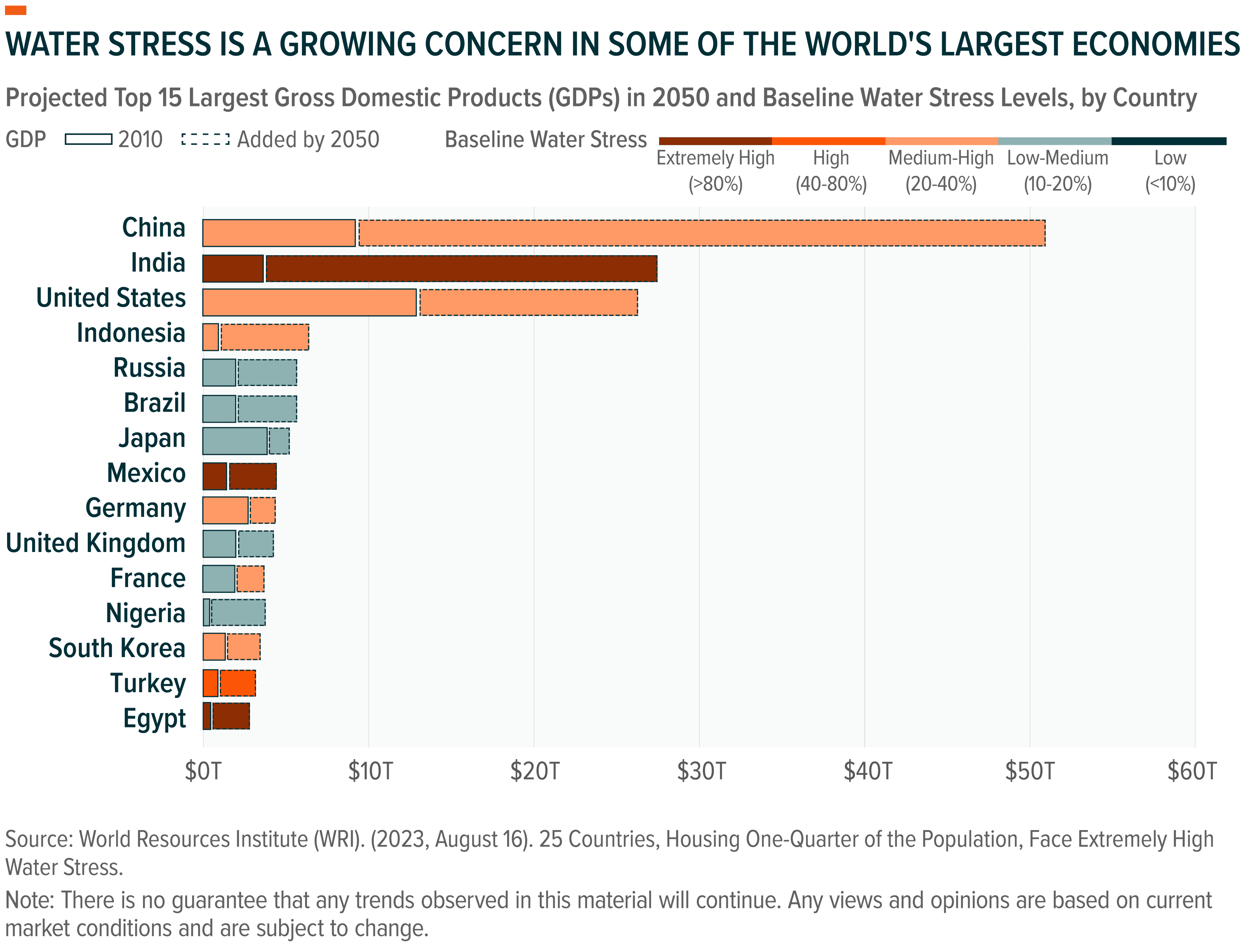
Water stress occurs when water demand is greater than the available supply within a specific area, and it is becoming an increasingly significant global challenge. In 2023, 25 countries accounting for one-fourth of the global population faced extremely high water stress, including India, the United Arab Emirates, and Chile.⁷ By 2050, countries housing an additional one billion people may face extreme water stress.⁸ This could equate to about 31% of global gross domestic product (GDP), or about $70 trillion, becoming exposed to high water stress by the middle of the century.⁹
Furthermore, dozens more countries that are home to much of the global population may continue experiencing at least medium-high water stress.¹⁰
Growing demand for water is one reason for the mounting water stress. Overall, global water demand is projected to potentially increase by as much as 25% by 2050, due to growth in the global population, as well as an expansion of water-reliant industries.¹¹
On the supply side of the equation, water availability in many regions is being affected by unsustainable water use and inadequate water infrastructure.¹² For example, in the 2025 Report Card for America’s Infrastructure, U.S. drinking water infrastructure received a C- overall grade due to aging infrastructure systems, unreliable data, and increasing vulnerability to extreme weather.¹³ Shifting weather and climate patterns add further uncertainty to the long-term availability of water resources around the world.
The impacts of inadequate water supplies are already becoming apparent for many communities and industries around the world. For example, in June 2025, barges along the Rhine River could carry only 40% to 50% of their typical capacity due to low water levels from persistent drought conditions.¹⁴ This led to surging shipping costs and delays for industrial shipments that rely on the river.¹⁵ In 2024, several reservoirs throughout Mexico reached historic deficits due to drought conditions, resulting in unpredictable access to water for citizens and businesses alike.¹⁶,¹⁷ From 2022 to 2024, severe drought conditions in Panama led to a frequent and severe operational disruptions at the Panama Canal.¹⁸
The agriculture, food and beverage, power, and mining industries are some of the other water-intensive industries that could face rising operational risks and impacts from water stress.¹⁹ Around 70% of the world’s freshwater consumption is used for agriculture, so droughts can have significant impacts.²⁰ In 2024, within the United States alone, major weather and fire events resulted in $20.3 billion in total losses to crops and rangeland.²¹ In the mining sector, 50% of lithium mine production and 52% of copper mine production are located in areas marked as high-risk for water stress.²²
The advancement of AI is expected to increase water consumption from data centre operations, creating another complex challenge for both hyperscalers and water utilities.²³ Data centres can require significant amounts of water to cool their processing chips. Large data centres are estimated to use up to 5 million gallons of water per day, which is roughly equivalent to the water use of a town of up to 50,000 people.²⁴ They can also lead to higher water use for power generation, depending on their location.²⁵ By 2028, global water consumption from cooling and power for AI data centres could total 1.068 trillion liters of water annually, which would be an 11x increase from 2024 estimates.²⁶
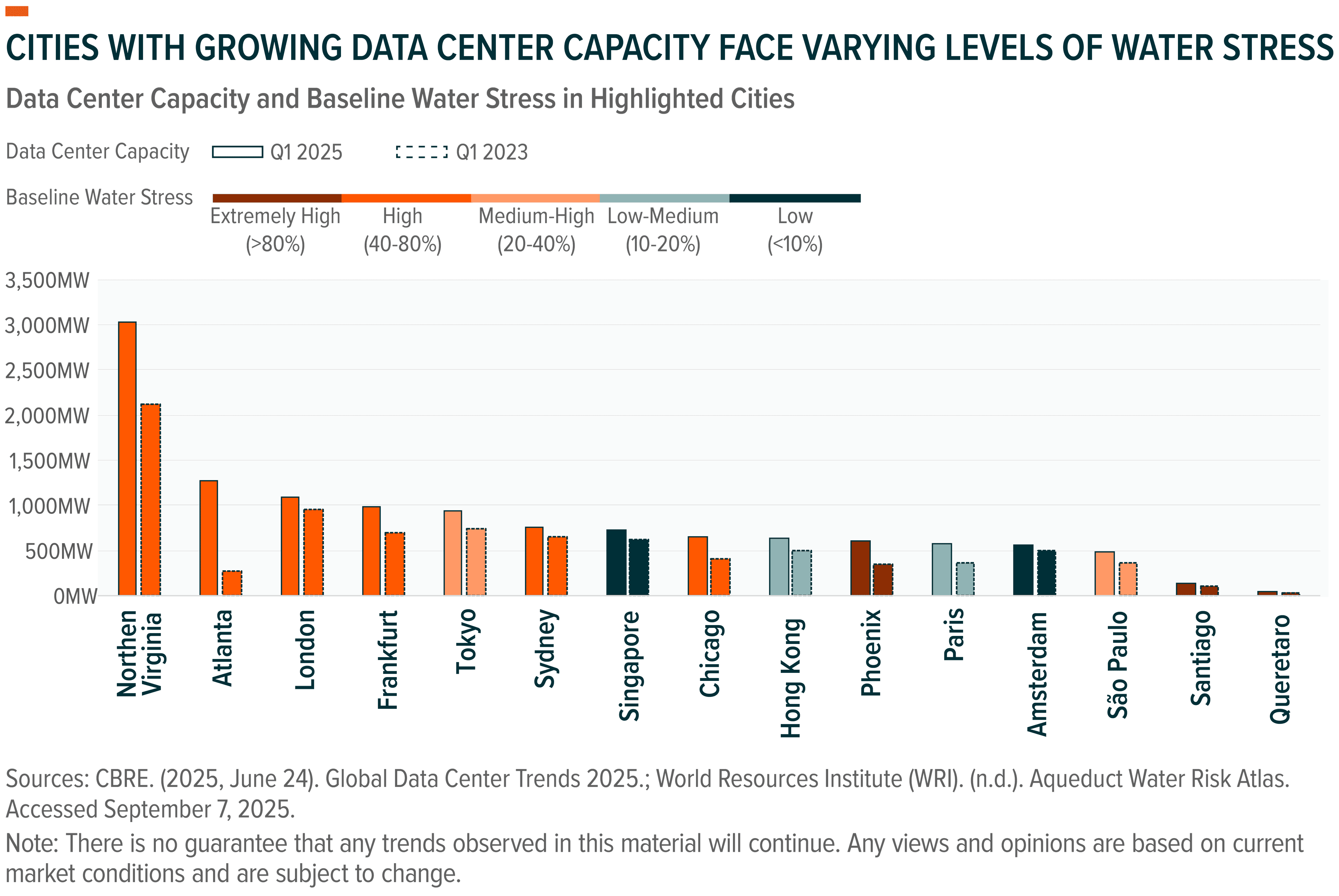
Much of the AI-fuelled growth in data centres is taking place in areas already experiencing water-related risks. In the United States, the world’s largest data centre market, nearly 66% of data centres built or in development are located in areas with high levels of water stress.²⁷ Other key data centre markets such as London and Sydney also face high baseline water stress.²⁸
Hyperscalers are working with utilities, cities, and water technology providers to help mitigate water-related risks. In September 2025, Xylem partnered with Amazon and two municipalities in Mexico – Monterrey and Mexico City – to deploy technologies that can help reduce water losses and create a more water-resilient future for the two cities.²⁹ Xylem CEO Matthew Pine noted that “this partnership is a model for how hyperscalers and communities can collaborate to ensure water security for both businesses and residents.”³⁰ Also in 2025, Google completed a water sustainability project in partnership with the city of The Dalles, Oregon, to improve water quality and resilience.³¹ Google has been operating data centres in the city since 2006 and has plans to upgrade and expand its facilities in the area.³² In January 2026, Microsoft announced its Community-First AI Infrastructure Plan, which includes steps the company can take to reduce water use from data centres.³³
Environmental and industrial tailwinds, as well as supportive policies, could lead to new growth opportunities for companies throughout the clean water value chain. This includes manufacturers of water control, storm resilience, and advanced water products such as Mueller Water Products, Badger Meter, Core & Main, Advanced Drainage Systems, and Xylem, as well as utilities such as American Water in the United States and United Utilities in England.³⁵,³⁶,³⁷,³⁸ Product manufacturers and service providers that can yield more sustainable water use could benefit from an expanding regulatory landscape in Europe and elsewhere. Furthermore, desalination companies could also benefit should more governments and companies turn towards the technology in water-scarce locations.³⁹
The positive sentiment has been shared by management teams from several companies. For example, during Xylem’s Q3 2025 earnings call, CEO Matthew Pine stated, “alongside data centre buildouts, water demand is growing across key verticals like power generation, chip fabrication, and mining for essential minerals.”⁴⁰ On Ferguson Enterprises Inc.’s Q1 2026 earnings call, management stated that it continues to see the pipeline for large capital projects, such as data centres, continue to grow, and that it remains bullish on the segment being a continued growth area.⁴¹
Mueller Water Products’ September 2025 presentation highlights several challenges facing U.S. utilities that create investment needs, such as aging infrastructure assets, water scarcity, and climate change.⁴² The presentation also notes $55 billion in water-related funding from the Infrastructure Investment and Jobs Act, which could lead to new projects for companies throughout the U.S. clean water value chain.⁴³
Many communities and water-intensive industries could see new disruptions to water supplies in the future. Fortunately, there are products, technologies, and services that can help governments and companies begin to mitigate risks associated with water quality and availability. A growing realisation of the challenges the world faces regarding clean water is spurring government action and private-sector innovation, creating potential investment opportunities. As clean water becomes increasingly in focus, the equipment producers, utilities, and service providers at the forefront of these solutions stand to potentially benefit.
This document is not intended to be, or does not constitute, investment research as defined by the Financial Conduct Authority.
1) United Nations. (2025, July 14). The Sustainable Development Goals Report 2025.
2) Global Commission of the Economics of Water. (2023, March). Turning the Tide: A Call to Collective Action.
3) MIT News. Explained: Generative AI’s environmental impact. 17 January 2025.
4) Ibid.
5) World Resources Institute (WRI). (2023, August 16). 25 Countries, Housing One-quarter of the Population, Face Extremely High Water Stress.
6) Voegele, J., Gouled, M., & Tafara, E. (2024, March 19). Scaling Up Finance to Ensure a Water-Secure Future for All. World Bank Blogs.
7) World Resources Institute (WRI). (2023, August 16). 25 Countries, Housing One-quarter of the Population, Face Extremely High Water Stress.
8) Ibid.
9) Ibid.
10) Ibid.
11)Ibid
12) Reuters. Looming water supply bankruptcy puts billions at risk, UN report warns. 20 January 2026.
13) American Society of Civil Engineers (ASCE). (2025, March 25). 2025 Report Card for America’s Infrastructure.
14) Ship Universe. (2025, June 30). Summer Drought Causes Severe Rhine Freight Disruptions.
15) Ibid.
16) Bloomberg. (2024, June 5). Drought Hampers Manufacturing in Mexican State Bordering Texas.
17) The New York Times. (2024, May 18). Mexico City Has long Thirsted for Water. The Crisis Is Worsening.
18) CNBC. (2025, September 13). Inside the Panama Canal’s mega-project plan to engineer its way through severe droughts of the future.
19) World Meteorological Organization (WMO). (2025). Water.
20) Ibid.
21) Munch, D. (2025, February 18). Farmers Lost $20.3 Billion to Weather Disasters in 2024. American Farm Bureau Federation.
22) International Energy Agency (IEA). (2024, May). Global Critical Minerals Outlook 2024.
23) Gorey, J. (2025, October 17). Data Drain: The Land and Water Impacts of the AI Boom. Lincoln Institute of Land Policy.
24) Ibid.
25) Ibid.
26) Shalett, L. & Skelly, D. (2025, October). On the Markets: Waiting for Fall. Morgan Stanley.
27) Bloomberg. (2025, May 8). AI Is Draining Water From Areas That Need It Most.
28) World Resources Institute (WRI). (n.d.). Aqueduct Water Risk Atlas. Accessed December 10, 2025.
29) Xylem. (2025, September 11). Xylem and Amazon Partner on Smart Water Upgrades to Save More Than 1.3 Billion Liters Annually in Mexico.
30) Yahoo!Finance. (2025, October 28). Xylem Inc. (XYL) Q3 FY2025 earnings call transcript.
31) Data Centre Dynamics. (2025, October 23). Google launches water sustainability project in The Dalles, Oregon.
32) Ibid.
33) Microsoft. (2026, January 13). Building Community-First AI Infrastructure.
34) Business Research Insights. Water and Wastewater Treatment Market Size. 9 February 2026.
35) USDAnalytics. Water metering and monitoring system market to reach $11.5 billion by 2034, driven by smart meters and digital twin adoption. 26 September 2025.
36) BusinessWire. American Water reports strong third quarter 2025 results. 29 October, 2025.
37) Ofwat. Ofwat’s forward programme 2025-2026. 1 March 2025.
38) American Water. American Water Participates in Companywide Fly-In to Meet with Congressional Leadership. 17 July, 2025.
39) WISE Freshwater. Water reuse. 2 October 2025.
40) Yahoo!Finance. (2025, October 28). Xylem Inc. (XYL) Q3 FY2025 earnings call transcript.
41) Seeking Alpha. (2025, December 9). Ferguson Enterprises Inc. (FERG) Q1 2026 Earnings Call Transcript.
42) Mueller Water Products. (2025, September 2). Where Intelligence Meets Infrastructure.
43) Ibid.